
NOVEMBER 2025
Research / Findings
Organized Breast Cancer Screening Program in Italy
A Nationally Guaranteed Service
Breast cancer screening in Italy is one of the three organized cancer screening programs included among the Essential Levels of Care (LEA), ensuring that every eligible person receives free and structured access to early detection services. The program targets women aged 50 to 69, who are invited every two years to undergo a mammogram within an organized and quality-controlled framework.
Since the early 2000s, all Italian regions have implemented the program under the coordination of the Ministry of Health and regional screening centres. In recent years, several regions have extended invitations to younger women (45–49 years) and older women (70–74 years), aligning with European Council recommendations and the National Cancer Plan 2023–2027.
What Are the LEA?
LEA (Livelli Essenziali di Assistenza) are the Essential Levels of Care guaranteed to all residents across Italy. They define the set of health services — prevention, diagnosis, treatment, and rehabilitation — that must be provided uniformly and free of charge by the National Health Service (SSN) throughout the country.
In cancer prevention, this means that every regional health authority must:
• actively invite all eligible people within the target age range;
• offer the full screening pathway (invitation, test, diagnosis, and follow-up) free of charge;
• monitor quality and equity of access through standardized national indicators.
➡ In practice: screening programs are not optional; they are a fundamental right of every citizen
Invitation coverage and participation in 2024
In 2024, a total of 4,185,888 women aged 50–69 were invited to participate in organized breast cancer screening, representing an invitation coverage of 97.3% — an increase of nearly 4 percentage points compared to 2023. The Northern and Central regions reached the recommended standard of up to 95%, while the South and Islands area remained slightly beyond the threshold. Anyway, the South continues to show steady progress, improving from 58% coverage in 2021 to 87.5% in 2024.
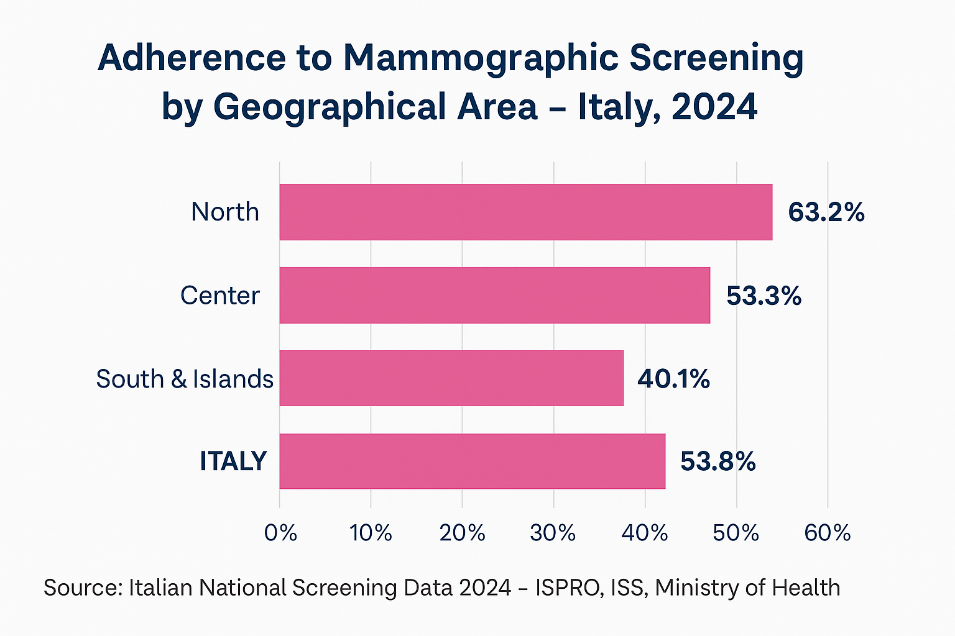
The participation rate (corrected adherence) reached 53.8%, slightly below the 2023 figure (55%), but still above the minimum acceptable threshold for program effectiveness (50%).
Regional differences in participation rate remain significant:
• Northern regions: 63.2%
• Central regions: 53.3%
• Southern regions and Islands: 40.1%
Values range from 22.1% in Calabria to 82.7% in Trentino-Alto Adige, confirming persistent geographical inequalities.
Extension to Additional Age Groups
As mentioned before, several regions have expanded the screening offer to younger and older age groups:
• Ages 45–49: Overall invitation coverage reached 33.8%, with seven regions exceeding 40%. The average participation rate was 58.1%.
• Ages 70–74: Coverage reached 51.3%, with eleven regions surpassing 50%. The national participation rate was 64.5%, ranging from 41.2% (Marche) to 93.1% (Friuli Venezia Giulia).
These extensions contribute to ensuring continuity of care across a broader population spectrum. The graph below shows adherence to mammographic screening among women aged between 50 and 69.
Reducing Inequalities and Strengthening Participation
Despite the solid performance of the national program, the North–South gap remains a critical challenge, with participation differences exceeding 23 percentage points.
To address these disparities, outreach and inclusion initiatives are being developed to improve access for vulnerable, rural, and underserved populations, particularly in southern regions and smaller islands.
Continuous monitoring, quality assurance, and regional collaboration remain key pillars of Italy’s strategy to ensure equitable cancer prevention across the country.
Expected Advances
Under the 2023–2027 National Cancer Plan, Italy aims to:
• strengthen interregional cooperation and digital reporting systems,
• enhance citizen awareness through targeted communication campaigns,
• and promote wider adoption of extended age-range screening.
These actions reinforce Italy’s commitment to effective, inclusive, and evidence-based breast cancer prevention.
Paola Mantellini (ISPRO), Elisa Betti (ISPRO)
Subscribe to our newsletter to get news and updates.







This project has received funding from the European Union’s EU4HEALTH Programme under the Grant Agreement no 101162959