
NOVEMBER 2025
Research / Findings
Organized Cervical Cancer Screening in Italy
Cervivcal cancer screening in Italy is one of the three organized cancer screening programs included in the Essential Levels of Care (LEA), ensuring equal and free access for all eligible people. The program targets women aged 25–64, who are invited to undergo HPV-based screening (every 5 years) or Pap-test (every 3 years), depending on regional protocols.
Since the early 2000s, all regions have implemented the program under the coordination of the Ministry of Health and regional screening centres. The transition from cytology-based to HPV-based screening has significantly improved early detection effectiveness and program efficiency.
Understanding the National Centre for Screening Monitoring (ONS)
The data presented in this newsletter are collected and analysed by the National Centre for Screening Monitoring (ONS), Italy’s technical body responsible for monitoring and supporting the country’s organized screening programmes. Established in 2001 as a network of regional screening centres, the ONS was formally integrated into the national governance system in 2011 and now serves as a key reference point for both the Ministry of Health and the Regions.
Its work includes developing operational guidance, coordinating information systems, ensuring quality assurance, and providing continuous monitoring and evaluation of programme performance.
ONS also leads annual national surveys and publishes the official reports that track coverage, participation, and impact across all regions. Through its training, research, and communication activities, the ONS plays a central role in strengthening the effectiveness and equity of cancer screening in Italy.
Invitation Coverage and Participation in 2024
In 2024, 4,048,525 people were invited to participate in the organized cervical cancer screening — an increase compared to 2023 (3,982,378).
The invitation coverage reached 117.2%, reflecting catch-up efforts for previous delays.
Regional differences remain substantial, with coverage ranging from 74.3% in Calabria to 167.9% in Marche.
Values above 100% are expected, given different test intervals and the recovery of pending invitations from previous years.
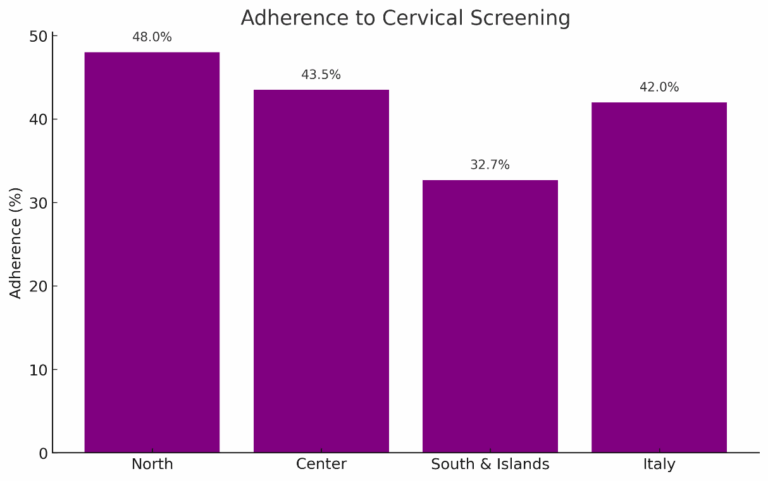
Participation also improved slightly: 1,624,149 people responded to the invitation (up from 1,554,540 in 2023), corresponding to an overall adherence of 42% (41.5% in 2023).
Regional variation is marked:
• Friuli Venezia Giulia recorded the highest participation rate (71.9%),
• while Calabria showed the lowest (15.4%).
By macro-area:
• North: invitation coverage 112.6% and a slight drop in adherence in comparison to 2023 (-3.6 percentage points (pp),
• Centre: 120.1% invitation coverage and an increase of 5 pp in adherence (43.5%),
• South & Islands: 108.1% invitation coverage and an increase of 1.4 pp in participation (32.7%).
Despite persistent inequalities, the trend remains positive, with participation growing steadily year after year (from 39% in 2021 to 42% in 2024).
Cervical cancer screening in Italy is one of the three organized cancer screening programs included in the Essential Levels of Care (LEA), ensuring equal and free access for all eligible people. The program targets women aged 25–64, who are invited to undergo HPV-based screening (every 5 years) or Pap-test (every 3 years), depending on regional protocols.
Since the early 2000s, all regions have implemented the program under the coordination of the Ministry of Health and regional screening centres. The transition from cytology-based to HPV-based screening has significantly improved early detection effectiveness and program efficiency.
Invitation Coverage and Participation in 2024
In 2024, 4,048,525 people were invited to participate in the organized cervical cancer screening — an increase compared to 2023 (3,982,378).
The invitation coverage reached 117.2%, reflecting catch-up efforts for previous delays.
Regional differences remain substantial, with coverage ranging from 74.3% in Calabria to 167.9% in Marche.
Values above 100% are expected, given different test intervals and the recovery of pending invitations from previous years.
Participation also improved slightly: 1,624,149 people responded to the invitation (up from 1,554,540 in 2023), corresponding to an overall adherence of 42% (41.5% in 2023).
Regional variation is marked:
• Friuli Venezia Giulia recorded the highest participation rate (71.9%),
• while Calabria showed the lowest (15.4%).
By macro-area:
• North: invitation coverage 112.6% and a slight drop in adherence in comparison to 2023 (-3.6 percentage points (pp),
• Centre: 120.1% invitation coverage and an increase of 5 pp in adherence (43.5%),
• South & Islands: 108.1% invitation coverage and an increase of 1.4 pp in participation (32.7%).
Despite persistent inequalities, the trend remains positive, with participation growing steadily year after year (from 39% in 2021 to 42% in 2024).
The graph below shows adherence to cervical cancer screening by geographic area among women aged 25-64.
Reducing Inequalities and Strengthening Participation
While overall performance meets the effectiveness threshold (≥50% coverage from test uptake), the North–South gap remains significant (around 25 percentage points).
National and regional programs are reinforcing outreach and inclusion actions to improve participation among vulnerable populations, particularly in southern and insular regions.
Expected Advances
Under the 2023–2027 National Cancer Plan, Italy aims to:
• further integrate HPV testing as the standard screening tool across all regions,
• adoption of a personalised invitation protocol according to HPV vaccination status,
• strengthen communication strategies to raise awareness of the HPV test,
• and enhance equity monitoring through shared national indicators.
These initiatives will contribute to reducing cervical cancer incidence and mortality, consolidating Italy’s position among European countries with the most advanced prevention systems.
Paola Mantellini (ISPRO), Elisa Betti (ISPRO)
Subscribe to our newsletter to get news and updates.







This project has received funding from the European Union’s EU4HEALTH Programme under the Grant Agreement no 101162959