NOVEMBER 2025
Research / Findings
Organized Colorectal Cancer Screening Program in Italy
A Nationally Guaranteed Service
Colorectal cancer screening in Italy is one of the three organized cancer screening programs included among the Essential Levels of Care (LEA). This guarantees that every eligible citizen receives free and structured access to early detection services. The program targets people aged 50 to 69, who are invited every two years to perform a fecal occult blood test (FOBT) within an organized, quality-assured framework. Since the early 2000s, all Italian regions have implemented colorectal screening under the coordination of the Ministry of Health and regional screening centres. In line with European Council recommendations and the National Cancer Plan 2023–2027, some regions have extended invitations to people aged 70–74, reinforcing continuity of care for older populations.
How Screening Governance Works in Italy
The governance of colorectal cancer screening in Italy reflects the broader structure of the National Health Service (SSN), which operates across three institutional levels.
• At the national level, the Government and the Ministry of Health, supported by technical–scientific bodies such as the National Institute of Health, define overall strategies, quality standards, and resource allocation.
• Regions and Autonomous Provinces are responsible for implementing these national directions, organizing screening pathways, coordinating regional screening centres, and ensuring that programmes comply with national principles.
• At the local level, territorial health authorities manage day-to-day operations: they handle invitations, testing logistics, reporting, and follow-up care, working closely with communities to facilitate access and participation.
This multi-layered structure ensures consistency in national objectives while allowing each region to tailor screening delivery to local needs.
Invitation Coverage and Participation in 2024
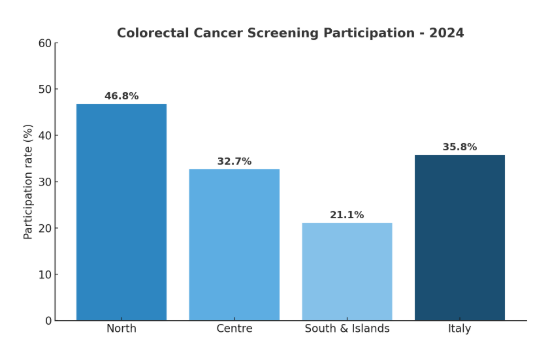
In 2024, 7,984,447 people aged 50–69 were invited to participate in the colorectal cancer screening program — corresponding to an invitation coverage of 94%, in line with 2023. Coverage remains almost complete in Northern and Central Italy (99%), while the South and Islands continue to make progress, reaching 84.5%, up from 79.7% in 2023 and just 61% in 2022. Participation (corrected adherence) reached 35.8%, an increase of almost one percentage point compared to 2023. Geographical differences persist: • Northern regions: 46.8% participation • Central regions: 32.7% • Southern regions and Islands: 21.1% Values range from 5.2% in Calabria to 66.4% in Valle d’Aosta, highlighting ongoing inequalities despite steady improvement in southern regions. The graph below shows adherence to colorectal cancer screening among persons aged between 50 and 69.
Extension to Additional Age Groups
In 2024, several regions expanded the program to include citizens aged 70–74. Overall invitation coverage for this group reached 34.9%, with seven regions exceeding 40%. Coverage ranged from 47.5% in Campania to 96.9% in Lombardy. Participation among those invited was 45.4%, with regional variation from 17.7% in Campania to an impressive 93% in Friuli Venezia Giulia. This extension contributes to a more inclusive and comprehensive prevention system for the Italian population.
Reducing Inequalities and Strengthening Participation
Despite consistent national progress, significant North–South disparities remain, with a participation gap exceeding 25 percentage points. To address these challenges, national and regional health authorities are developing targeted initiatives to: • increase accessibility for rural and underserved areas, • strengthen public awareness about the importance of early detection, and • improve data integration and coordination across regions. Continuous monitoring, quality assurance, and interregional collaboration remain essential to ensure equitable cancer prevention across Italy.
Expected Advances
Under the National Cancer Plan 2023–2027, Italy aims to: • promote wider participation through citizen education and simplified testing pathways, • enhance the digital reporting system to improve efficiency and traceability, • and support the progressive extension of the screening offer to older age groups. These coordinated efforts confirm Italy’s ongoing commitment to effective, inclusive, and evidence-based colorectal cancer prevention.
Paola Mantellini (ISPRO), Elisa Betti (ISPRO)
Subscribe to our newsletter to get news and updates.







This project has received funding from the European Union’s EU4HEALTH Programme under the Grant Agreement no 101162959