Home » Campaign Country » Partnership, equity and a shared vision: Ireland’s progress towards cervical cancer elimination
Partnership, equity and a shared vision
Ireland’s progress towards cervical cancer elimination
Cervical Cancer Elimination
By 2040, Ireland aims to make cervical cancer rare in every community. Ireland’s experience offers an example of how coordinated national action, partnership, community engagement and system-wide collaboration can turn global goals into local progress.
A clear national commitment
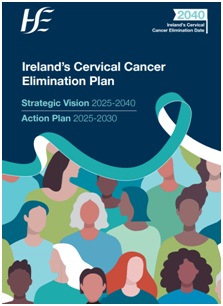
Ireland publicly announced in 2023 that it is on track to eliminate cervical cancer by 2040. One year later, in 2024, we published our Cervical Cancer Elimination Action Plan 2025-2030 after extensive consultation with health professionals, community groups, patient advocates and members of the public.
The Plan
The plan sets out our national roadmap aligned with the World Health Organization’s (WHO) global strategy, focusing on:
- HPV vaccination to prevent HPV infection
- HPV cervical screening to detect early changes and prevent cervical cancer
- timely diagnosis and treatment for anyone who needs it
A year of action and measurable impact
On 17 November 2025, for the first official World Cervical Cancer Elimination Day, Ireland marked both a milestone and a moment to reflect on what we have achieved so far, and what still needs to be done.
Ireland’s Cervical Cancer Elimination Partnership published its first annual progress report capturing how health services, community organisations and patient representatives have worked together to begin delivering on our ambition.
The Report
The report shows how our commitments are translating into measurable progress across vaccination, screening and treatment:
- HPV vaccination: Ireland maintained strong delivery of the school-based HPV vaccination programme and took steps to strengthen this, supported by legislative changes as well as addressing lower uptake in some communities
- HPV cervical screening: Preparations advanced for a national feasibility study on HPV self-sampling to expand access. New training programmes and guidance to support screening for people who have experienced trauma or barriers to care were introduced.
- Continued improvements to the national cervical screening register have progressed to improve data quality and equity monitoring
- Early diagnosis and treatment: A primary care guidance note was developed to strengthen the referral pathways for women presenting with symptoms. International evidence was reviewed for adoption in Ireland to enhance the management of early-stage cancers.
Together, these actions show that we are moving from aspiration to implementation – supported by evidence, partnership and a sustained commitment to equity.
Equity at the centre
Ireland’s elimination effort is guided by a fundamental principle: elimination must be meaningful for every community.
This equity lens is central to our approach and reflects a growing priority across Europe and globally to make sure prevention and screening programmes benefit all people, particularly those historically underserved.
Our progress report shows that significant work has taken place to improve equity, including:
- Community-based pilot projects with Roma, Traveller and migrant communities helped co-design culturally appropriate information on HPV vaccination
- Trauma-informed care initiatives supported people who had previously faced barriers to access screening
- Market research and behavioural science work providing insight into practical barriers such as lack of access to GPs, uncertainty about the cervical screening test, or low awareness that screening was free
National action through local participation
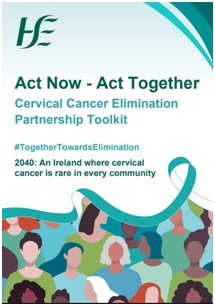
To support widespread participation in Ireland’s vision to make cervical cancer rare in every community, we developed a comprehensive cervical cancer elimination communications toolkit. The toolkit is designed for use by communities, civil society organisations, schools, workplaces and health services all year round.
Resources
The resources include:
- Ready-to-use factsheets
- Social media graphics and sample posts
- Printable posters
- Links to videos and accessible information on HPV vaccination and cervical screening
The toolkit helps communities to share accurate information, increase awareness and build confidence in vaccination, screening and early treatment across diverse communities. It also supports equity by ensuring that consistent, clear and accessible information is available so that everyone can understand it and act on it.
Enabling long-term progress
As well as the clinical and service-based achievements, Ireland advanced four key enabling pillars – essential to long-term progress:
- Partnerships, advocacy and communications: strengthening collaboration across the health system and improving access to trusted, plain-language public information
- Workforce and education: building skills and capacity for trauma-informed and culturally competent care
- Research: expanding the Irish evidence base, informed by international learning, to make sure decisions are grounded in what works
- Data, monitoring and evaluation: improving the availability and use of data to track year-on-year progress and maintain alignment with WHO targets
Priorities for 2026 and beyond
Ireland has prepared to progress several major actions in 2026, including:
- Launching an HPV self-sampling feasibility study
- Expanding targeted vaccination supports in schools and communities
- Further improving the national screening register and equity monitoring
- Broadening the dataset and metrics reported on to monitor progress
- Continuing workforce training in trauma-informed and culturally competent care
- Publishing annual progress reports to support accountability and shared learning
Sharing our learnings
Ireland’s progress shows what is possible when national leadership meets community partnership, with elimination treated as a practical, collective responsibility.
Our journey to date offers valuable learning on:
- Embedding equity in national strategies
- Using behavioural science to understand barriers
- Building community partnerships
- Strengthening data quality and monitoring
- Sustaining public confidence in vaccination and screening
- Mobilising national action around global milestones
Lighting the way to elimination
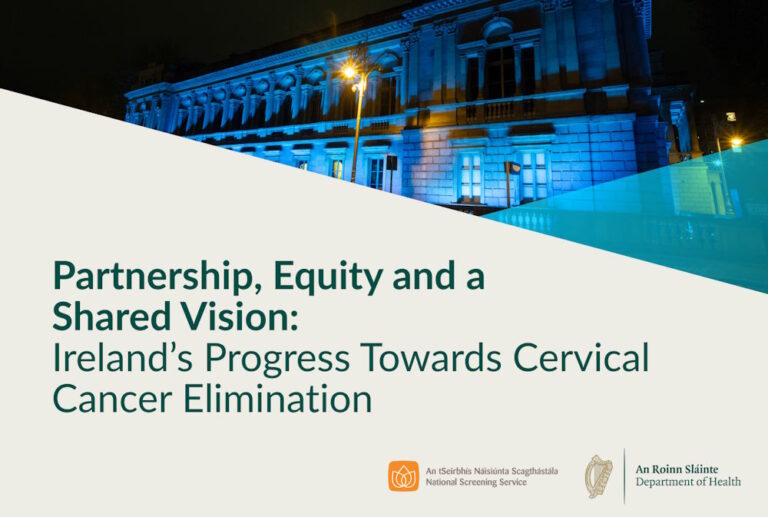
As part of the global illumination initiative, Office of Public Works buildings across Ireland – from the Rock of Cashel in Tipperary to Dublin’s Custom House – joined iconic landmarks around the world and illuminated in teal on World Cervical Cancer Elimination Day to raise awareness of the global elimination effort.

Together towards elimination
Elimination is achievable through shared effort. As European partners working together to improve population screening and reduce inequalities, we can learn from each other’s successes, challenges and innovations.
We are united under a single aim: elimination must be achieved for everyone, in every community, in every country.
Keep up to date with Ireland’s journey to cervical cancer elimination at hse.ie/cervicalcancerelimination.
Subscribe to our newsletter to get news and updates.







This project has received funding from the European Union’s EU4HEALTH Programme under the Grant Agreement no 101162959