Home » Campaign Country » Raising awareness about cancer screening across Ireland: From personal stories to equity-driven campaigns
Raising awareness about cancer screening across Ireland
From personal stories to equity-driven campaigns
HSE National Screening Service
Every year, in the HSE National Screening Service, we run national awareness campaigns to help people understand the importance of cancer screening – and to encourage them to take part when they’re invited.
From eye-catching social media posts, and radio ads, to real-life stories, our campaigns are designed to reach people with messages that matter.
Here we share a few standout examples of how we’re helping more people make informed choices about screening.
How a patient story about bowel screening inspired action
In 2024, we partnered with Mary Kennedy, a member of our Patient and Public Partnership, to share her bowel screening story. Mary’s cancer was found through BowelScreen – Ireland’s national bowel screening programme, even though she had no symptoms.
Together, we co-designed a social media campaign that shared her message: the importance of taking part in screening when you feel well.
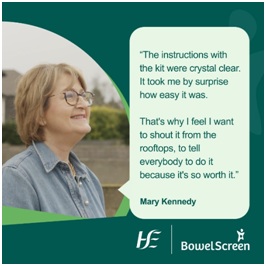
The campaign reached hundreds of thousands of people and achieved above-average engagement, driving thousands of visits to our BowelScreen website and contributing to a 15% increase in overall web traffic that year.
Mary’s story showed the power of real, human stories to build trust, connect emotionally, and motivate action. It’s a strong example of how we co-design campaigns with patients and partners to raise awareness and encourage more people to choose screening.
Read more about this successful social media campaign and watch Mary’s video below.
An equity-driven cervical screening campaign shaped by women’s voices
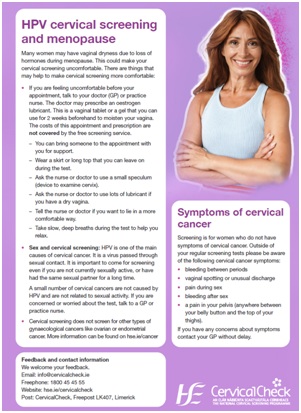
CervicalCheck’s equity-driven communications for women in their 60s showed the power of listening and responding to women’s voices.
When women who had just missed out on HPV cervical screening in 2020 because of their age asked for the opportunity to take part in HPV screening, we acted. We co-designed a clear, compassionate and evidence-based information campaign to reach more than 100,000 women aged 60 to 69 with a one-time offer of HPV testing.
- An equitable approach: We invited all women in the project’s age range for one HPV screening test
- Evidence-based communications: we developed our materials based on research which showed that women over 50 are less likely to attend cervical screening due to fear of the test and discomfort after menopause
- Tailored materials: we developed a personalised invitation letter explaining why women were being invited; and a one-page leaflet which gave practical information on how to make the test more comfortable for women
- Motivational messaging: We used behavioural science insights to motivate women to learn more and take part in screening
- Co-design and testing: We tested the materials with members of our Patient and Public Partnership and women in the same age range who had expressed interest in HPV testing
- Support for healthcare professionals: We developed and delivered bespoke communications for GPs and nurses to help them discuss the test confidently with women in this age range
- National campaign: We ran a national campaign at the same time we sent the invitation letters to women to explain the benefits of HPV cervical screening, and how to book an appointment
This collaborative, inclusive and evidence-informed approach helped over 26,000 women to take up the offer of screening – showing that when we design communications with equity and empathy at the core, we can overcome barriers and extend the benefits of screening to more people.
Read more about this CervicalCheck project and the results it yielded.
How an emotional story drove BreastCheck engagement
In 2025, we partnered with our Patient and Public Partnership representative, Dympna Cremin, whose breast cancer was found through BreastCheck – Ireland’s national breast screening programme. We co-designed a digital campaign grounded in Dympna’s personal story.
Working closely with Dympna, we shaped content that reflected her authentic voice and experience. Her testimonial became a short, emotionally engaging video and accompanying copy that connected deeply with women eligible for BreastCheck. The campaign ran on Facebook and Instagram. We used A/B testing to compare emotional storytelling with more factual, informational messaging.
The results were clear: emotion outperformed information. The campaign reached more than 350,000 people and generated over 1.6 million impressions. Ads featuring Dympna’s personal story achieved higher engagement and stronger results across all metrics, including video views and clicks to the BreastCheck registration page. This confirmed that authentic, user-led narratives are more effective at inspiring women to take action than purely informational messages.
Our key learning is that co-creating campaigns with patient partners makes communications more relatable and impactful. Storytelling rooted in lived experience drives both awareness and behaviour change. Future campaigns can build on this success by involving patients from the start, blending emotional and factual content, and including clear calls to action to turn engagement into participation.
Watch Dympna’s video.
Across our campaigns, collaboration is key – with patients, partners and healthcare professionals. By listening and co-designing, we’re learning to create communications that build trust, motivate action and reduce inequalities in screening, as well as raising awareness. We hope these experiences can support and inspire others across Europe who are working to make screening more equitable and effective for everyone.
Priority Area 2 relates to education, training, and development and Priority Area 5 pertains to communications. We are applying learning from these to Work Package 6 (addressing barriers and facilitators in cancer screening) of the EUCanScreen project.
- Mary and Dympna also shared their stories in the Breakthrough Cancer Research ‘Cancer Revolution’ exhibition which ran from August to October 2025 in Dublin, Ireland
- Follow the HSE National Screening Service on X @NSShse, on LinkedIn and follow the hashtag #ChooseScreening
- The National Screening Service is part of Ireland’s Health Service Executive (HSE). Keep up to date with our latest news at screeningservice.ie
Subscribe to our newsletter to get news and updates.






This project has received funding from the European Union’s EU4HEALTH Programme under the Grant Agreement no 101162959