The National Breast Cancer Screening Programme in Iceland
Iceland is working to make breast cancer screening easy, inclusive, and accessible to all

Early Detection
Population-based breast cancer screening using mammography has been offered to women in Iceland since 1987, with the objective of reducing breast cancer mortality through early detection.
National Guidelines
Until 2021, the programme was managed by the Icelandic Cancer Society. Responsibility has since been transferred to the Cancer Screening Coordination Centre, which operates under the Primary Health Care of the Capital Area. The Centre coordinates and organises the screening programme, including issuing invitations in accordance with national guidelines, communicating results, and providing public information to support informed participation.
Quality & Performance
The Directorate of Health has overall oversight of the programme. Its responsibilities include issuing screening guidelines, defining quality indicators and performance benchmarks, and conducting quality assurance through monitoring outcomes and implementation.
Mammography Examinations
Mammography examinations are performed at the Breast Screening Centre at Landspítali University Hospital and at Akureyri Hospital in North Iceland. In addition, mobile screening units operate during spring and autumn, providing services in rural areas to ensure equitable access regardless of residence. All mammograms are interpreted by radiologists at Landspítali University Hospital.
Results & Follow-up
Women aged 40–74 years are eligible for screening. Women aged 40–69 are invited every two years, while women aged 70–74 are invited every three years. Invitations are sent via digital mailboxes and traditional postal mail. Women with normal findings receive results digitally and are invited to their next screening, while those with abnormal findings are referred for further assessment and follow-up.
Participation Rates
In 2024, the participation rate in breast cancer screening was 61%, below the target of 75%. Participation varies substantially across population groups. Women with Icelandic citizenship had an attendance rate of 67%, compared with 23% among women with non-Icelandic citizenship. Lower participation has also been observed among younger women and in certain geographical areas. Despite these disparities, participation has gradually increased across all subgroups in recent years.
Ensure Equitable Access
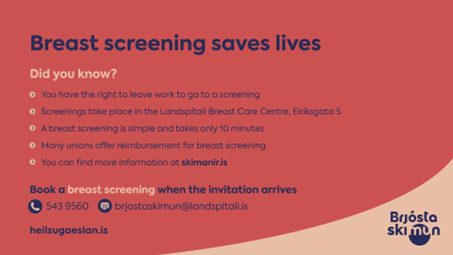
To improve uptake and promote equity, several measures have been implemented. In 2024, the Ministry of Health reduced the out-of-pocket fee for mammography from approximately €40 (6,000 ISK) to €3 (500 ISK), significantly lowering financial barriers to participation. Informational materials, including invitation letters, have been translated into English and Polish, and multilingual posters have been distributed in public spaces.
Encouraging Participation
These materials provide practical information about screening and inform women of their right to take time off work to attend appointments. The Cancer Screening Coordination Centre also conducts year-round targeted social media campaigns to encourage participation.
W.O.M.E.N.
Targeted outreach to migrant women has included collaboration with the Women of Multicultural Ethnicity Network in Iceland (W.O.M.E.N. in Iceland) and other stakeholders. Activities have included discussion meetings and an open house at the Breast Screening Centre, offering information and opportunities to familiarise migrant women with the screening process, supported by interpretation services.
Public Health Impact
Iceland’s breast cancer screening programme is a well-established national initiative with strong governance and quality oversight. While participation remains below target, recent improvements and targeted measures demonstrate a clear commitment to equity and continued public health impact.
Subscribe to our newsletter to get news and updates.






This project has received funding from the European Union’s EU4HEALTH Programme under the Grant Agreement no 101162959