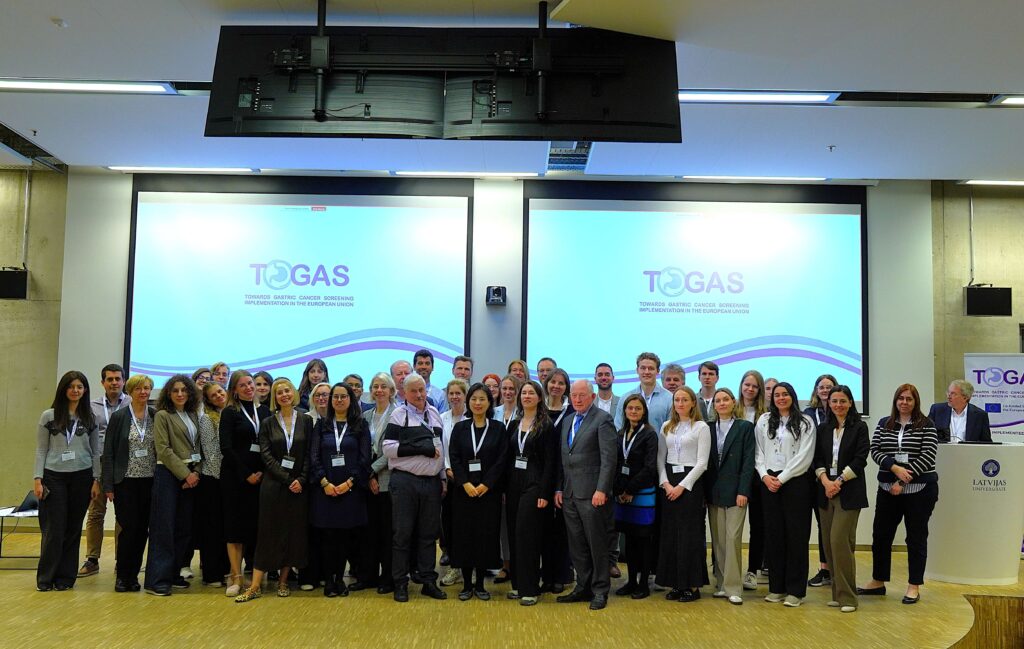
On 11 May 2026, the Closing Consortium Meeting of the TOGAS (Towards Gastric Cancer Screening Implementation in the European Union) project took place at the University of Latvia (LU), the House of Science in Riga, Latvia. The meeting brought together project partners from across Europe, representatives from the European Commission’s DG SANTE and the European Health and Digital Executive Agency (HaDEA), as well as members of the External Advisory Board.
TOGAS is a European project, co-funded by the European Union (EU) and coordinated by the LU, dedicated to reducing the burden of gastric cancer through the development of innovative approaches to screening and early detection. The project evaluates the current situation and needs of EU Member States in the field of gastric cancer prevention, including existing opportunistic screening initiatives in both public and private healthcare settings, while also assessing the suitability of different screening methods for implementation across Europe. Through three pilot studies focusing on specific aspects of gastric cancer screening and prevention, TOGAS examines issues such as effectiveness, cost-efficiency, and medical ethics, with the aim of supporting sustainable, evidence-based screening strategies aligned with European guidelines and quality assurance frameworks.
The meeting was opened by Professor Marcis Leja (LU), who welcomed participants and outlined the project’s overall progress and the role of TOGAS within the broader European cancer screening landscape. Representatives from DG SANTE and HaDEA presented on the project’s contribution to the implementation of Europe’s Beating Cancer Plan.
A central part of the meeting was dedicated to the results of three pilot studies conducted within the project:
Pilot Study 1 – H. pylori screen-and-treat strategy for primary gastric cancer prevention in young adults across six EU member states (Bojan Tepes, NIJZ);
Pilot Study 2 – Combined upper and lower gastrointestinal cancer screening and its benefits beyond cancer detection (Jan Bornschein, LU);
Pilot Study 3 – Long-term effects of H.pylori eradication in a middle-aged population (Danute Razuka-Ebela, LU).
The afternoon sessions focused on the findings, covering public and policymaker attitudes towards gastric cancer screening, patient-reported experiences, general population survey data, cost-effectiveness modelling of gastric cancer prevention, and overall project evaluation.
The meeting concluded with a forward-looking presentation by Kateryna Priadko and Iveta Enina (LU) introducing the upcoming TOGAS Plus project, signalling the continuation of the shared commitment to bringing gastric cancer screening to EU member states.

Views and opinions expressed are however those of the author(s) only and do not necessarily reflect those of the European Union or European Health and Digital Executive Agency (HADEA). Neither the European Union nor HADEA can be held responsible for them.
This website is managed by 6th DYPEDE, Greece.