Home » Newsletters » Together Against Cancer Inequalities: Why European Week Against Cancer Still Matters
MAY 2026
Community Engagement & Feedback
Together Against Cancer Inequalities: Why European Week Against Cancer Still Matters
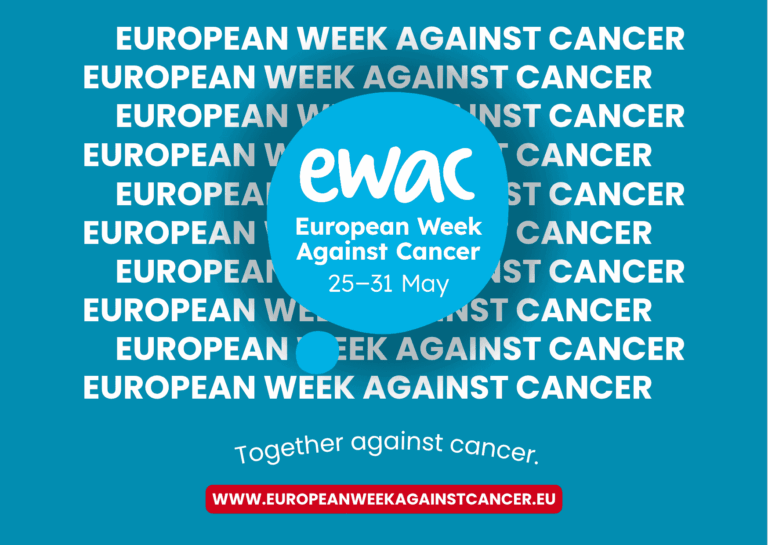
European Week Against Cancer 2026: Together Against Inequalities
Every year, from 25 to 31 May, organisations, clinicians, patients, and policymakers across the continent turn their attention to the same goal: reducing the toll that cancer takes on European lives. This is the European Week Against Cancer (EWAC), a flagship campaign led by the Association of European Cancer Leagues (ECL), an umbrella body representing dozens of national and regional cancer leagues. The week always opens on 25 May and closes on 31 May, which is also World No Tobacco Day — a fitting bookend, given that tobacco remains the single largest preventable cause of cancer.
The theme for 2026 is “Together against cancer inequalities,” and it points to an uncomfortable truth. Cancer does not affect everyone equally. Where you live, how much you earn, your level of education, and your access to a doctor can shape whether a tumour is caught early or caught too late. The campaign’s central argument is that closing these gaps is not a luxury — it is one of the most effective ways to save lives.
The Scale of the Problem
Cancer is among the leading causes of death in Europe. In 2022 alone, the disease was responsible for an estimated 1.3 million deaths across the region. Behind that number are families, careers, and communities reshaped by diagnosis and loss. Yet the most striking fact about cancer is also the most hopeful: a large share of cases are preventable. Lifestyle factors, environmental exposures, infections, and gaps in screening account for a significant proportion of the cancer burden. That means the choices we make as individuals — and the policies we make as societies — genuinely move the needle.
A Week Built Around the Whole Journey
One of the strengths of EWAC is that it refuses to reduce cancer to a single message. Instead, each day of the week shines a light on a different stage of what experts call the “cancer continuum”:
- Primary prevention — stopping cancer before it starts
- Early detection — catching it when treatment works best
- Access to treatment — making sure care reaches everyone who needs it
- Digital health and care — using technology to extend and improve services
- Research — building the knowledge that drives every other advance
- Patients and survivors — centring the people living with and beyond cancer
- World No Tobacco Day — confronting the biggest preventable risk factor of all
This structure makes a quiet but important point. Beating cancer is not one battle but many, fought at the same time by researchers, nurses, advocates, and ordinary people changing their daily habits.
Prevention is in Your Hands — Partly
At the heart of the campaign sits the European Code Against Cancer, a set of evidence-based recommendations describing practical steps individuals can take to lower their risk. The advice is refreshingly straightforward and, taken together, can meaningfully reduce a person’s chances of developing the disease:
- Don’t smoke and avoid second-hand smoke.
- Keep a healthy body weight and stay physically active.
- Eat a healthy diet, with plenty of wholegrains, vegetables, fruit, and legumes, and limit processed foods, red meat, salt, and sugary drinks.
- Limit alcohol — and for cancer prevention, less is always better.
- Protect your skin from too much sun.
- Reduce exposure to harmful substances at work and at home, including radon in living spaces.
- Take part in vaccination programmes such as hepatitis B and HPV vaccination.
- Attend organised cancer screening when invited — for breast, cervical, and colorectal cancers in particular.
The deliberate inclusion of screening and vaccination alongside lifestyle advice is no accident. Personal choices matter, but so does access to programmes that many people cannot reach on their own. Which brings us back to inequality.
Why “Inequalities” is the Right Focus
It is easy to frame cancer prevention purely as a matter of willpower — eat better, drink less, move more. But the 2026 theme insists on a fuller picture. A person who cannot easily reach a clinic, who has never been invited to a screening programme, or who lives in a region with under-resourced healthcare faces obstacles that no amount of personal determination can fully overcome.
These disparities show up between countries and within them, cutting along lines of income, geography, and education. A cancer that is highly survivable in one community can be a death sentence in another, simply because of when and how it is detected and treated. Tackling this is partly a medical challenge and partly a political one — a question of how health systems are funded, organised, and made accessible to everyone.
How to Get Involved
European Week Against Cancer is designed to be participatory, and there are many ways to take part, whether you are an organisation or an individual:
- Share the message. ECL provides a campaign toolkit with ready-made materials, social media content, and templates that organisations can translate and brand for local audiences.
- Host or join an event. Webinars, community gatherings, and online actions take place across the continent throughout the week.
- Act on the European Code Against Cancer. Book that overdue screening appointment, check whether you and your family are up to date on relevant vaccinations, or make one concrete change to your daily habits.
- Speak up. Use the week to ask local and national decision-makers what they are doing to close the gaps in prevention, screening, and treatment.
A Shared Responsibility
The enduring lesson of European Week Against Cancer is captured in its 2026 framing. Real progress against cancer is rarely the work of a single heroic breakthrough. It is the cumulative result of millions of small actions — a screening attended, a cigarette not smoked, a policy improved, a community reached that was previously left out.
For one week each May, Europe makes that collective effort visible. The harder, more valuable work is carrying it through the other fifty-one.
European Week Against Cancer runs from 25 to 31 May 2026 and is coordinated by the Association of European Cancer Leagues (ECL)
Authors
Joanna Velissari, Anna Viha, Angelos Koutras, Apostolos Vantarakis,DYPEDE Greece
Subscribe to our newsletter to get news and updates.
Views and opinions expressed are however those of the author(s) only and do not necessarily reflect those of the European Union or European Health and Digital Executive Agency (HaDEA). Neither the European Union nor HaDEA can be held responsible for them.
This website is managed by 6th DYPEDE, Greece.






This project has received funding from the European Union’s EU4HEALTH Programme under the Grant Agreement no 101162959