From Recommendations to Practice – Making Cancer Screening Accessible to Everyone
Equal Access to Cancer Screening Cannot Be Taken For Granted
Addressing Barriers
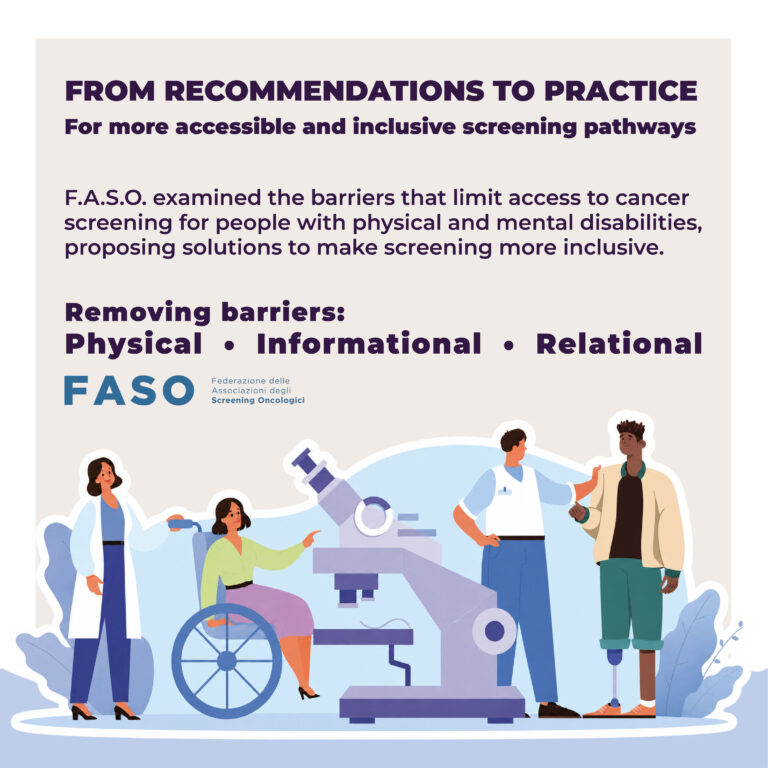
People with disabilities may face multiple barriers when trying to participate in screening programmes. Some are physical, such as inaccessible facilities or diagnostic equipment. Others concern information and communication, the organisation of services, or the ability of screening pathways to respond to different individual needs.
Addressing these barriers is not simply a matter of adapting individual services. It is a matter of health equity: ensuring that everyone has a real opportunity to benefit from cancer prevention.
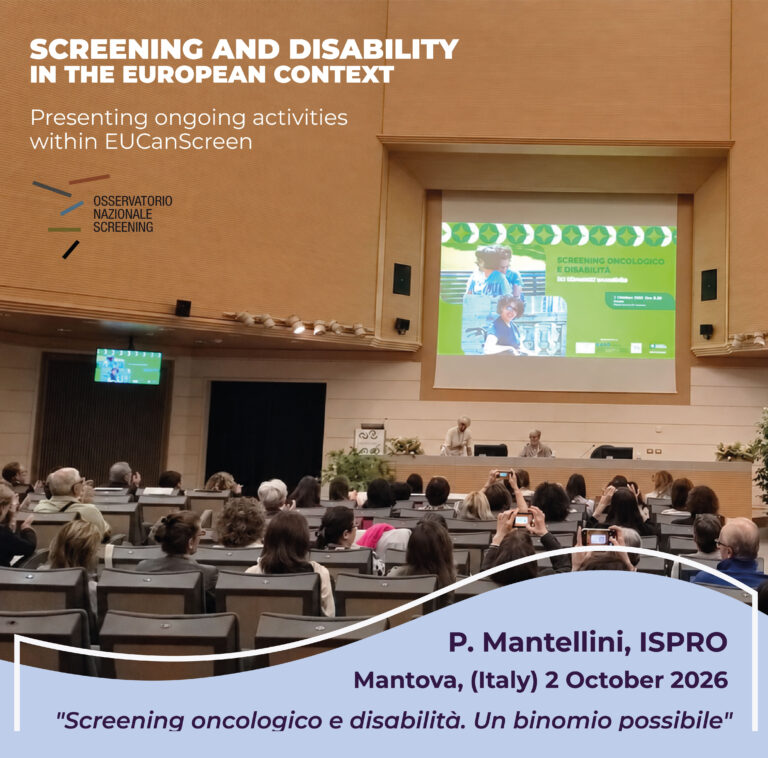
These issues were addressed at the conference “Screening oncologico e disabilità. Un binomio possibile” (“Cancer Screening and Disability: A Possible Combination”), held on 2 October in Mantova, which brought together national guidance, international perspectives and practical experiences from Italy.
Turning recommendations into action
A key reference for the discussion was the document “Raccomandazioni per l’offerta di screening oncologici alle persone con disabilità fisica e psichica” (“Recommendations for the Provision of Cancer Screening to People with Physical and Mental Disabilities”), published in December 2025 by FASO – Federazione delle Associazioni degli Screening Oncologici (Federation of Oncological Screening Associations).
Developed by a multidisciplinary group of professionals from different Italian regions, the recommendations examine the factors that can create inequalities in access to cancer screening for people with disabilities. They bring together scientific evidence, experiences, good practices and innovative models developed in Italy and internationally, translating them into concrete areas for action.
These include improving physical accessibility, making information and communication more accessible, strengthening the training of healthcare professionals, introducing greater organisational flexibility and actively involving people with disabilities and their associations in the development and evaluation of services.
But the recommendations also highlight a fundamental principle: inclusion does not mean creating separate or “special” screening pathways for people with disabilities. The goal is to act on existing screening pathways so that they can accommodate different needs and become truly accessible to everyone.
From national experience to the European perspective
The Mantova conference also placed the Italian experience within the wider European effort to reduce inequalities in cancer screening.
Ongoing activities within the EUCanScreen Joint Action were presented alongside national initiatives, providing an opportunity to connect approaches developed in Italy with the broader European discussion on accessibility and participation in screening programmes.
This connection reflects an important dimension of EUCanScreen’s wider activities: creating opportunities for countries to share experiences, approaches and solutions to common challenges. National and local practices can contribute to this European exchange, while knowledge developed through the Joint Action can, in turn, inform improvements within national screening systems.
What accessibility looks like in practice
The experience developed in Mantova provides a concrete example.
At ASST Carlo Poma, the Delfino-DAMA pathway provides protected and facilitated access to diagnostic and therapeutic services for people with intellectual and neuromotor disabilities. This established model has also supported the development of a more structured approach to cancer screening, adapting access and assistance to individual needs. Preliminary assessment helps identify organisational and logistical requirements and determine the level of support each person may need throughout the screening process.
The Mantova experience therefore shows how principles and recommendations can be translated into organisational solutions within existing services, taking different needs into account without creating parallel systems.
From national recommendations to local implementation and European exchange, the challenge is the same: ensuring that accessibility is embedded in cancer screening programmes.
🎗️ INCLUSIVE SCREENING IS NOT ABOUT CREATING SEPARATE PATHWAYS. IT IS ABOUT MAKING EXISTING PATHWAYS TRULY ACCESSIBLE TO EVERYONE!
The Italian EUCanScreen network brings together:
Istituto per loStudio e la Prevenzione e la Rete Oncologica, ISPRO
Istituto Superiore di Sanità
Ministero della Salute
Azienda Unità Sanitaria Locale di Reggio Emilia
Regione Marche
Azienda Ospedaliera Città della Salute e della Scienza di Torino
Azienda ULSS 4 Veneto Orientale
Istituto di Ricerche Farmacologiche Mario Negri
Università Cattolica del Sacro Cuore, UCSC
Provincia Autonoma di Trento
Fondazione IRCCS Istituto Nazionale dei Tumori
Regione Lombardia
Agenzia di Tutela della Salute di Pavia
Istituto Tumori “Giovanni Paolo II” IRCCS
Azienda Sanitaria Locale Taranto
#EUCanScreen #CoFunded #CancerScreening #Disability #HealthEquity #Accessibility #Italy #CountryCampaign #FASO
Subscribe to our newsletter to get news and updates.
Views and opinions expressed are however those of the author(s) only and do not necessarily reflect those of the European Union or European Health and Digital Executive Agency (HaDEA). Neither the European Union nor HaDEA can be held responsible for them.
This website is managed by 6th DYPEDE, Greece.






This project has received funding from the European Union’s EU4HEALTH Programme under the Grant Agreement no 101162959