Our vision: Screening Designed for People…WITH People
Shaping more transparent, effective and people-centered cancer screening initiatives
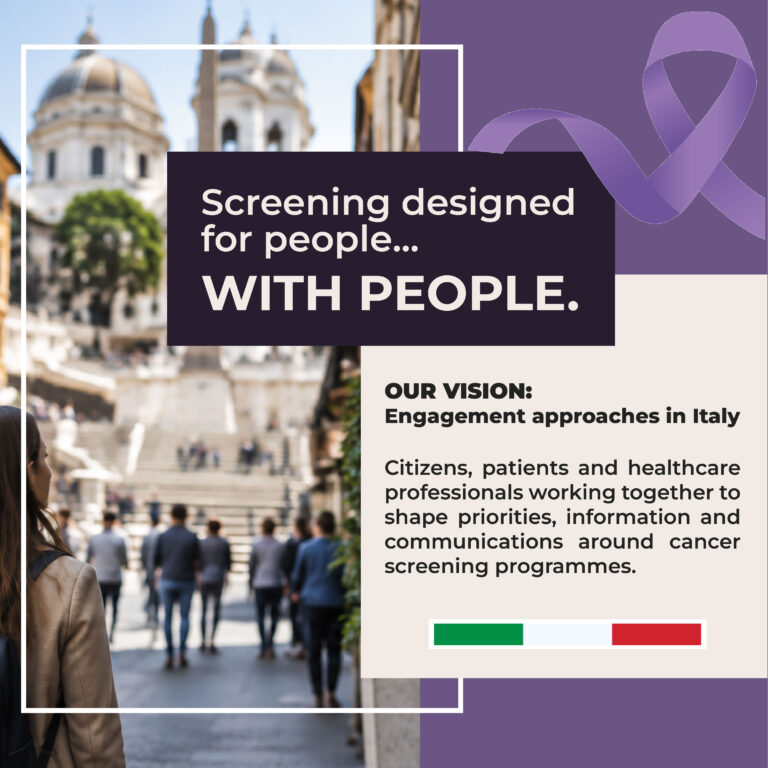
Shaping More Transparent, Effective and People-Centered Cancer Screening Initiatives
In Italy, stakeholder involvement and co-design frameworks are emerging as essential practices in shaping more transparent, effective and people-centered cancer screening initiatives.
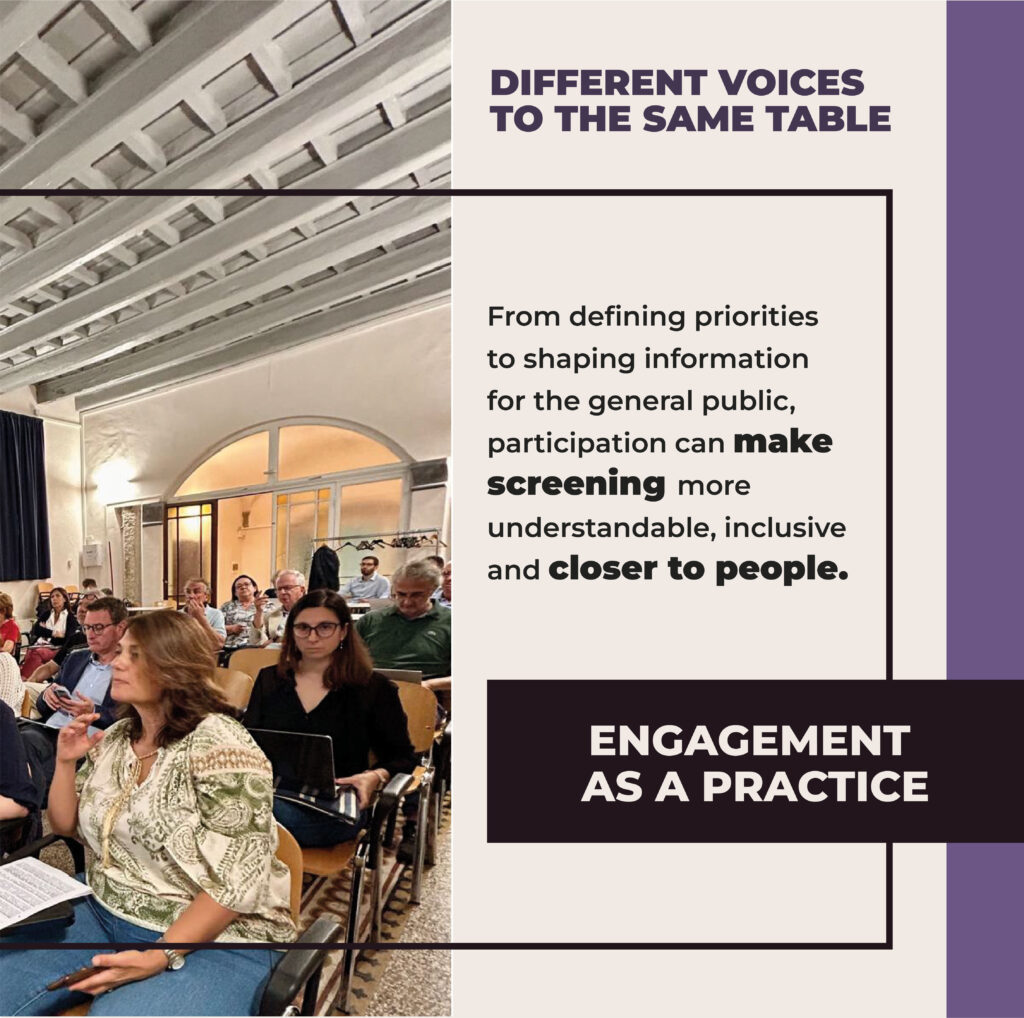
While full co-decision in routine screening implementation remains an ongoing goal, these collaborative experiences demonstrate that meaningful involvement goes beyond standard consultation. It requires structured frameworks—such as working groups, consultative forums, and deliberative processes—where citizens, patients, clinicians, communication, and public health experts can contribute to health governance.
Deliberative approaches in action: the Citizens’ Jury model
A pioneering example of structured public involvement in Italy was the Citizens’ Jury on Prostate Cancer Screening. Developed by the Partecipasalute project—coordinated by the Mario Negri Institute for Pharmacological Research in collaboration with the Italian Cochrane Centre and Zadig—it marked a milestone as the first deliberative experience applied to healthcare choices in Italy.
The model relies on a rigorous methodology: a selected group of citizens receives comprehensive, objective, and unbiased evidence regarding both the benefits and harms of a proposed health intervention. Facilitated by an independent moderator, participants examine the data to deliberate in the interest of public health.
In this landmark experience, 15 citizens spent two days listening to epidemiologists, screening experts, general practitioners, oncologists, health economists, and bioethicists. They deliberated on a complex clinical question regarding opportunistic PSA testing, proving that well-informed citizens can meaningfully engage with intricate scientific and ethical trade-offs.
Advancing co-design: the Prostate Cancer Screening Stakeholder Forum
Building on these foundations, Italy has recently addressed the 2022 European Council Recommendation on prostate cancer screening feasibility.
Under the Ministry of Health project “Valutazione della fattibilità di programmi organizzati sullo screening della prostata e loro efficacia nel ridurre l’inappropriatezza dell’uso del test del PSA nel contesto italiano” (“Feasibility evaluation of organized prostate cancer screening programs and their effectiveness in reducing inappropriate PSA test use in Italy”) – coordinated by Institute for Cancer Research, Prevention and Clinical Network (ISPRO) – a multi-institutional team launched a nationwide initiative.
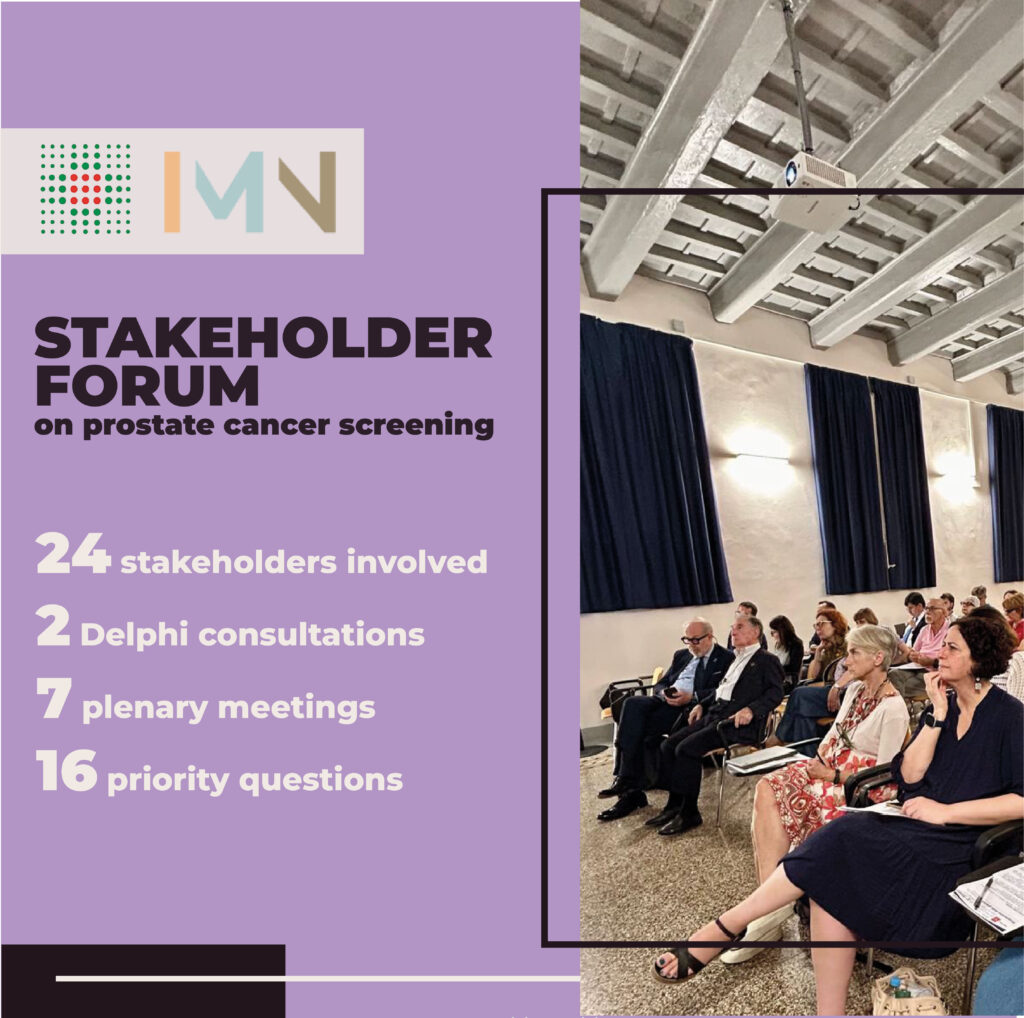
As part of this work, a Stakeholder Forum coordinated by Francesco Venturelli (Epidemiology Unit, AUSL-IRCCS of Reggio Emilia) brought together 24 key representatives, including citizens, patients, and healthcare users; clinicians and screening specialists; as well as public health, organizational, and communication experts.
Supported by targeted literature reviews, 2 Delphi consultation rounds, and 7 plenary sessions, this collaborative initiative led to the definition of 16 priority questions across four core areas:
- Data on the usage of PSA testing, recruitment methods, and pathway redesign
- Screening protocol
- Communication, training, and co-design
- Ethical, legal, social, and monitoring aspects
“When inviting patient representatives or individual citizens to the table, clarity is essential,” emphasizes Cinzia Colombo, researcher at the Mario Negri Institute. “It is crucial to clarify the exact goal of their involvement, the role and commitment expected, and how their contributions will be taken into account.”
Collaborations
The collaborative work within the Forum ensured that the priorities of patient associations directly informed the debate around screening design, placing central importance on evaluating programmes through patient-reported outcomes. This approach underscores that the true quality of a screening programme is measured not only by what it detects, but also by what it manages to avoid: unnecessary diagnoses, over-treatment, psychological burden, and systemic inequalities.
The Key to Building Trust
These Italian experiences show that engagement is the key to building trust. While the journey toward fully co-designed screening programmes is still a work in progress, Italy is actively laying the groundwork for a future where screening is truly designed for people…WITH PEOPLE.
#EUCanScreen #CoFunded #CancerScreening #Italy #CountryCampaign
Subscribe to our newsletter to get news and updates.
Views and opinions expressed are however those of the author(s) only and do not necessarily reflect those of the European Union or European Health and Digital Executive Agency (HaDEA). Neither the European Union nor HaDEA can be held responsible for them.
This website is managed by 6th DYPEDE, Greece.






This project has received funding from the European Union’s EU4HEALTH Programme under the Grant Agreement no 101162959