Advancing Risk-Stratified Cancer Screening
Italy's Contribution to EUCanScreen
Adapting Cancer Screening Programmes
Adapting cancer screening programmes to individual risk profiles is one of the areas being explored within EUCanScreen, the European Joint Action funded by the European Commission to support the expansion and strengthening of cancer screening programmes across Europe.
Italy and the introduction of risk-stratified screening programmes
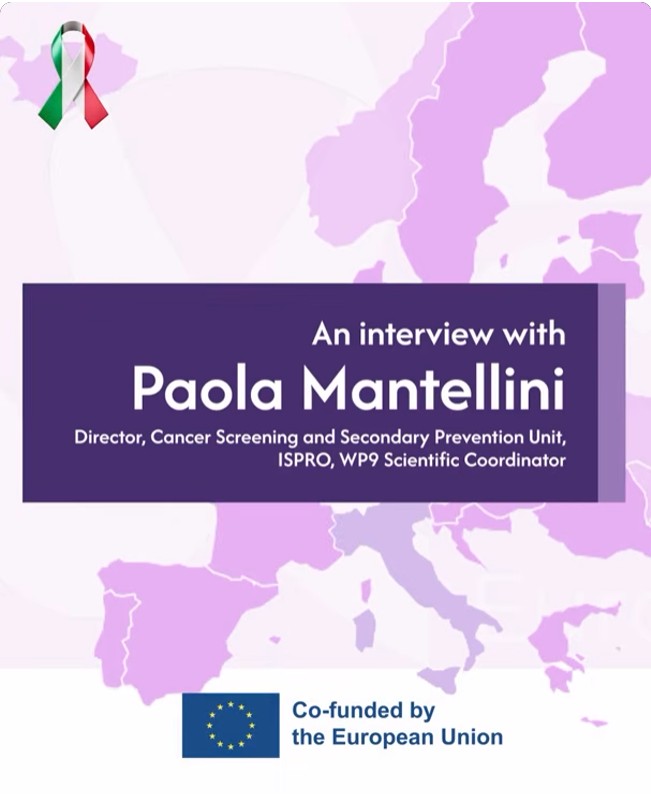
In the interview “Italy and the introduction of risk-stratified screening programmes”, Paola Mantellini, Director of the Cancer Screening and Secondary Prevention Unit at the Institute for Cancer Research, Prevention and Clinical Network (ISPRO), and Scientific Coordinator of EUCanScreen’s WP9, discusses Italy’s participation in the initiative and its contribution to the development of risk-stratified screening approaches.
Italy is actively involved in the Joint Action through 12 participating institutions, contributing in particular to activities focused on the potential introduction of risk stratification into existing screening programmes.
The Objective
As Paola Mantellini explains, the objective is to work with European partners to assess the available scientific evidence and identify criteria that could support the implementation of risk-stratified approaches at a local level.
Adapting screening pathways to individual risk
Risk-stratified screening involves tailoring screening strategies according to a person’s estimated level of risk, rather than applying the same screening pathway to everyone within an eligible population.
For people identified as being at higher risk, this could mean more frequent screening invitations, additional tests or different combinations of screening methods. Conversely, people at lower risk could potentially benefit from longer intervals between screening examinations and less intensive interventions, where supported by scientific evidence.
Breast, Colorectal and Cervical Cancer Screening
The approach is being explored primarily in relation to the three established population-based screening programmes in Italy: breast, colorectal and cervical cancer screening.
Different Risk Profiles
Through EUCanScreen, participating institutions will examine the evidence and work together to define how such approaches might be introduced into existing screening programmes, taking into account different risk profiles and local implementation needs.
Extending the evidence base to additional cancers
The work also extends beyond established screening programmes.
As highlighted in the interview, EUCanScreen partners will contribute to developing guidance on screening approaches for lung cancer, particularly among people with a history of heavy smoking, including current and former smokers.
Further activities will address prostate cancer screening and gastric cancer screening, particularly in geographical areas where gastric cancer is more common.
By bringing together institutions and expertise from across Europe, EUCanScreen aims to support evidence-informed decisions on the future organisation of cancer screening programmes.
Italy’s Participation
Italy’s participation in these activities supports a wider European effort to explore how screening strategies can be adapted to different risk levels, while supporting the development of practical guidance for their implementation.
#EUCanScreen #CoFunded #CancerScreening #Italy #CountryCampaign
Subscribe to our newsletter to get news and updates.
Views and opinions expressed are however those of the author(s) only and do not necessarily reflect those of the European Union or European Health and Digital Executive Agency (HaDEA). Neither the European Union nor HaDEA can be held responsible for them.
This website is managed by 6th DYPEDE, Greece.






This project has received funding from the European Union’s EU4HEALTH Programme under the Grant Agreement no 101162959