Using Data To Rethink Colorectal Cancer Screening
How data can shape more targeted colorectal cancer screening.
Colorectal cancer screening programmes collect valuable information that could help improve future screening strategies. Results from earlier screening rounds, combined with additional individual risk factors, may offer new opportunities to identify different levels of risk and develop more targeted screening protocols.
Within EUCanScreen, a dedicated subgroup of the working group on risk-stratified screening is examining how these approaches could be developed and introduced into colorectal cancer screening programmes.
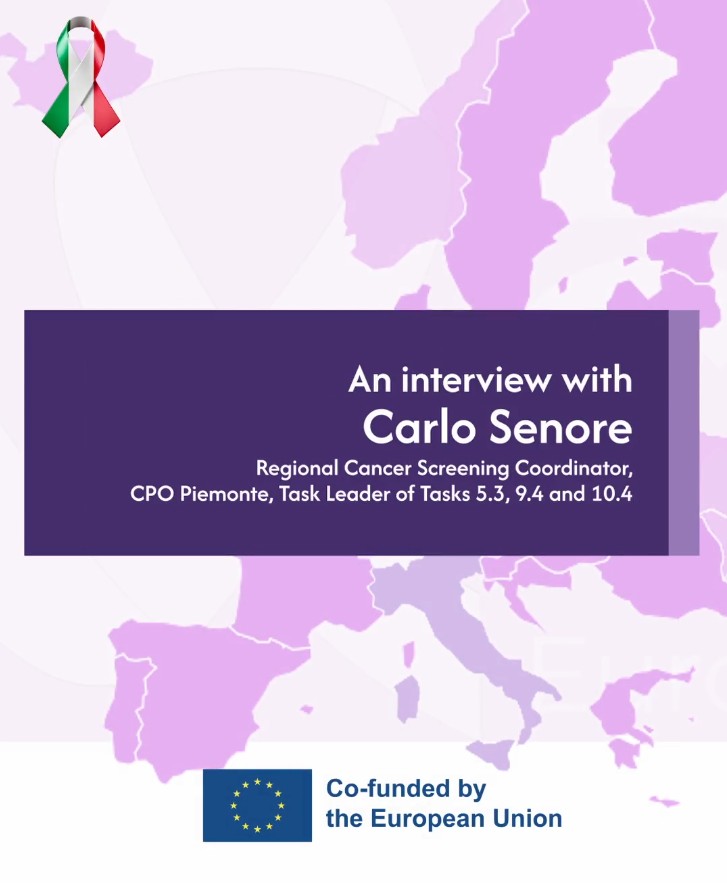
In this video interview, Carlo Senore, Regional Screening Coordinator, CPO Piemonte (Regional Reference Centre for Cancer Epidemiology and Prevention), and Task Leader of EUCanScreen Tasks 5.3, 9.4 and 10.4, discusses the research underway, the contribution of European collaboration and the challenges of collecting additional information without discouraging screening participation.
Using screening history to assess risk
One area of investigation focuses on information already available from earlier screening rounds, particularly the levels of faecal haemoglobin detected through faecal occult blood testing.
Studies conducted in Italy indicate that people with higher levels are more likely to have colorectal lesions. This information could help identify individuals who may benefit from further assessment, including colonoscopy, while supporting longer screening intervals for those with very low levels.
The objective is to make better use of limited healthcare resources, directing more intensive examinations towards people most likely to benefit and reducing potentially unnecessary procedures among those at lower risk.
Looking beyond screening results
Researchers are also exploring how lifestyle factors and environmental exposures could contribute to a more detailed assessment of individual risk.
Unlike screening results already recorded by healthcare services, this information must be collected directly from participants, potentially through dedicated questionnaires.
However, requesting additional information may affect people’s willingness to participate and raise concerns about equity, particularly for those with fewer resources, lower levels of education or less awareness of lifestyle-related health risks.
In Italy, a study funded by the Ministry of Health is examining the impact of lifestyle questionnaires on screening participation. Its findings could inform future communication strategies and invitation procedures, helping programmes collect relevant information without introducing unnecessary barriers.
Other research activities are also underway in Italy, including studies supported within the National Recovery and Resilience Plan (NRRP).
Strengthening research through European collaboration
Several European countries have developed pilot projects exploring risk-stratified colorectal cancer screening.
Within EUCanScreen, the working group aims to connect these experiences, encourage greater consistency between approaches and identify questions requiring further investigation.
Collaboration across different programmes could also provide access to larger datasets, enabling more detailed analyses and helping researchers address uncertainties that remain unresolved.
Evidence emerging from these activities could inform the future development of risk-based screening protocols, taking into account both their potential benefits and their implications for participation and equity.
Better screening strategies depend not only on the data we collect, but also on how we collect them.
Subscribe to our newsletter to get news and updates.
Views and opinions expressed are however those of the author(s) only and do not necessarily reflect those of the European Union or European Health and Digital Executive Agency (HaDEA). Neither the European Union nor HaDEA can be held responsible for them.
This website is managed by 6th DYPEDE, Greece.






This project has received funding from the European Union’s EU4HEALTH Programme under the Grant Agreement no 101162959