
There’s A Time For Everything. The Time For Prevention Is Now!
From screening to care: how Trentino is strengthening colorectal and cervical cancer prevention
Organised cancer screening extends far beyond simply offering a test. Its ultimate effectiveness relies on how citizens are guided through the care pathway, how diagnostic follow-up is managed, and how evidence is used to improve programmes over time.
From screening to care: two experiences from the Autonomous Province of Trento
Two initiatives in colorectal and cervical cancer screening illustrate the complementary dimensions of organised prevention: structured telephone counselling following a positive faecal occult blood test (FOBT) and the evaluation of primary HPV testing across successive screening rounds.
Colorectal cancer screening: counselling as a pathway to care
Within Trentino’s colorectal cancer screening programme, a positive FOBT marks the entry point into a structured pathway of personal care. Telephone counselling delivered by healthcare professionals is designed to do much more than simply communicate test results: it represents a key step in taking responsibility for the person and acts as a crucial bridge connecting first-level screening directly with Gastroenterology services.
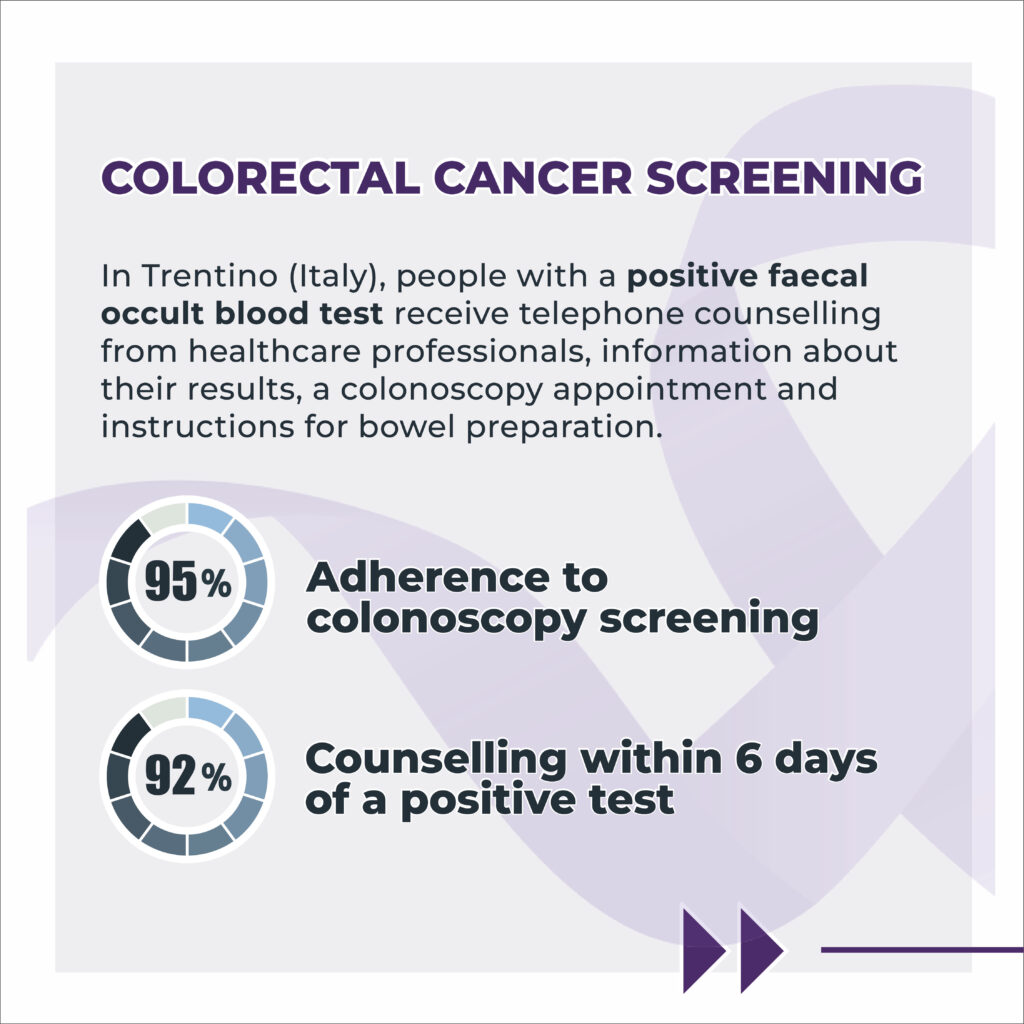
During counselling, participants are briefed on the implications of their result and the subsequent diagnostic steps. Healthcare professionals collect relevant clinical details for the endoscopist, schedule the colonoscopy appointment and provide precise instructions for bowel preparation. This approach relies on a strong territorial network: citizens are contacted by their local health district based on residence, facilitating access to bowel preparation and providing further opportunities to clarify instructions and address questions.
The programme records a 95% adherence rate to colonoscopy after a positive test, compared to a national average of 83.7%. Complete colonoscopies reach 97.9% (against 94.7% nationally), also accompained by high-quality bowel preparation. In 92% of cases, counselling took place within six days of the positive test.
These outcomes indicate that structured counselling can serve as a valuable organisational component of colorectal cancer screening, supporting access to diagnostic follow-up and continuity between the first and second levels of the screening pathway.
Cervical cancer screening: evaluating primary HPV testing
The Autonomous Province of Trento began its transition to primary HPV testing for cervical cancer screening in 2017. By 2022, women who had already undergone primary HPV screening were being invited to a subsequent round, creating a valuable opportunity to compare their results with those of women undergoing HPV testing for the first time.
The analysis focused on HPV positivity, triage Pap test positivity and the detection rate of cervical abnormalities of grade 2 or higher that are clinically relevant because of their potential to progress to cervical cancer (CIN2+ lesions).
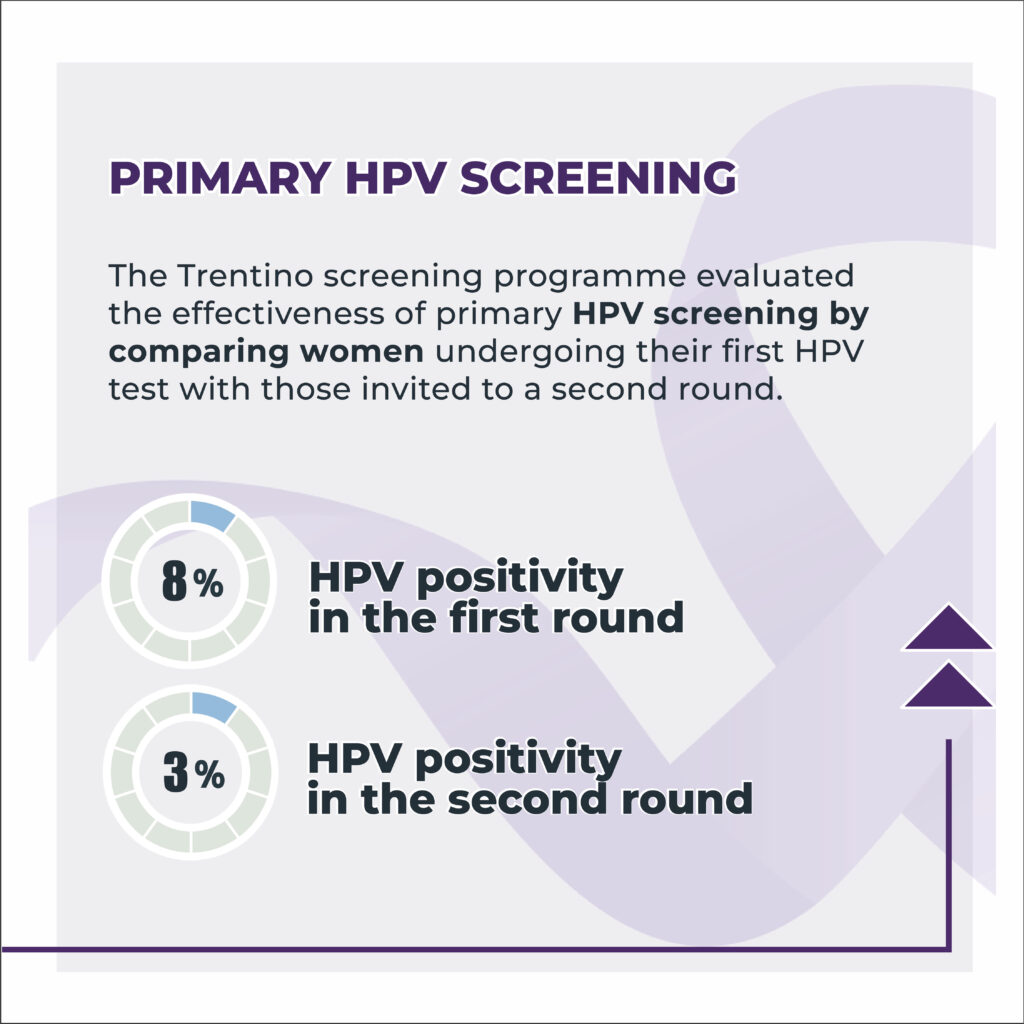
HPV positivity was 8% among women undergoing their first HPV test and 3% among women at the subsequent round. Among women undergoing Pap test triage, positivity decreased from 38% at the first round to 24% at the subsequent round. The detection rate of CIN2+ lesions was also lower at the subsequent screening round.
According to the programme evaluation, these findings support the effectiveness of introducing primary HPV testing into Trentino’s organised cervical cancer screening pathway: the first round helped identify women requiring further assessment, while the subsequent round showed lower HPV positivity, lower Pap test positivity at triage and fewer CIN2+ lesions detected.
Two pathways, one commitment to prevention
Although addressing different diseases and stages of care, both Trentino’s experiences share the same principle: effective screening goes beyond the test itself.
It means identifying people who need further assessment, ensuring timely follow-up, supporting them throughout the pathway and using evidence to continuously improve organised programmes. In colorectal cancer screening, this translates into structured counselling and continuity between screening and diagnostic assessment; in cervical cancer screening, into an evidence-based approach that allows the programme to evaluate primary HPV testing across successive screening rounds.
Different screening pathways, one shared goal: making prevention timely, organised and effective.
Subscribe to our newsletter to get news and updates.

Views and opinions expressed are however those of the author(s) only and do not necessarily reflect those of the European Union or European Health and Digital Executive Agency (HaDEA). Neither the European Union nor HaDEA can be held responsible for them.
This website is managed by 6th DYPEDE, Greece.






This project has received funding from the European Union’s EU4HEALTH Programme under the Grant Agreement no 101162959