
Organised Cancer Screening in Italy in 2025
Organised Cancer Screening Programmes for Cervical, Breast and Colorectal Cancer
Organised cancer screening programmes for cervical, breast and colorectal cancer are established public health interventions in Italy and are included in the Essential Levels of Care. They are provided free of charge and follow structured pathways that accompany people from the initial invitation through any necessary diagnostic assessment and, when required, treatment.
The standard offer includes cervical screening with a Pap test every three years for people aged 25 to 29 and an HPV test every five years from 30 to 64, biennial mammography for people aged 50 to 69, and a faecal occult blood test every two years for colorectal cancer screening among people aged 50 to 69.
National prevention and cancer plans, together with the 2022 Council of the European Union recommendations, have also supported the extension of mammographic screening to people aged 45 to 49 and 70 to 74, and colorectal screening to those aged 70 to 74. Some Regions have already introduced these extensions using their own resources. The new National Prevention Plan 2026 to 2031 confirms the need to extend these age groups throughout the country, supported by dedicated resources provided through the latest budget law.
The 2025 data collected by the National Screening Observatory refer to invitations issued during the year and participation recorded up to 30 April 2026. Invitation coverage measures the proportion of eligible people who received an invitation, while examination coverage measures the proportion of eligible people who actually underwent screening.
Within the Essential Levels of Care age groups, 15,976,679 people were invited in 2025 and 6,565,821 completed a screening test. An additional 1,740,562 people were invited in the age groups currently outside the Essential Levels of Care, with 948,706 participating.
Mammographic Screening
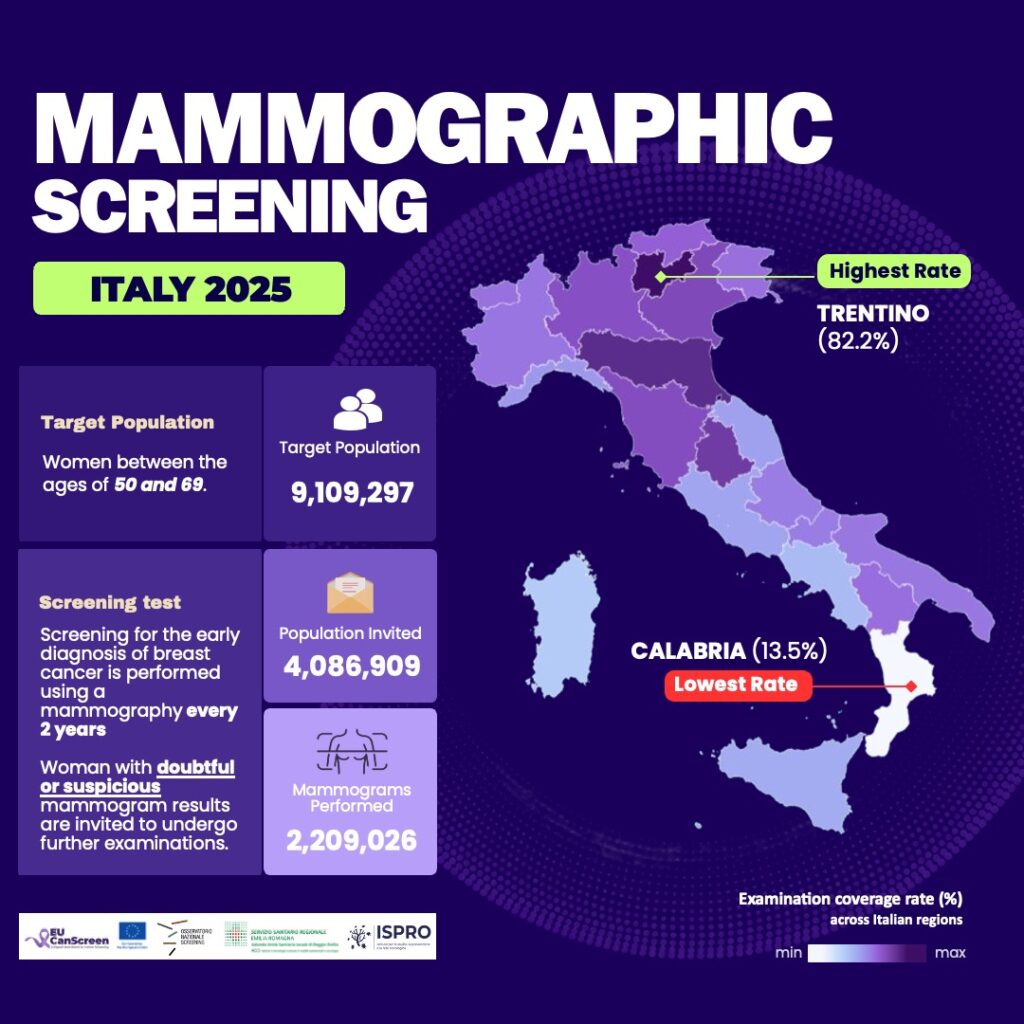
In 2025, 4,086,909 people were invited to mammographic screening and 2,209,026 mammograms were performed. National invitation coverage reached 96%, remaining above the 90% target for the second consecutive year.
Invitation coverage was complete in Northern and Central Italy, at 102% and 100% respectively, while Southern Italy and the Islands reached 86%.
National examination coverage was 53%, above the acceptable 50% threshold, with 63% in the North, 52% in Central Italy and 40% in the South and Islands. The five year trend shows relatively stable coverage in Northern and Central Italy and an increase in Southern Italy and the Islands.
Colorectal Screening
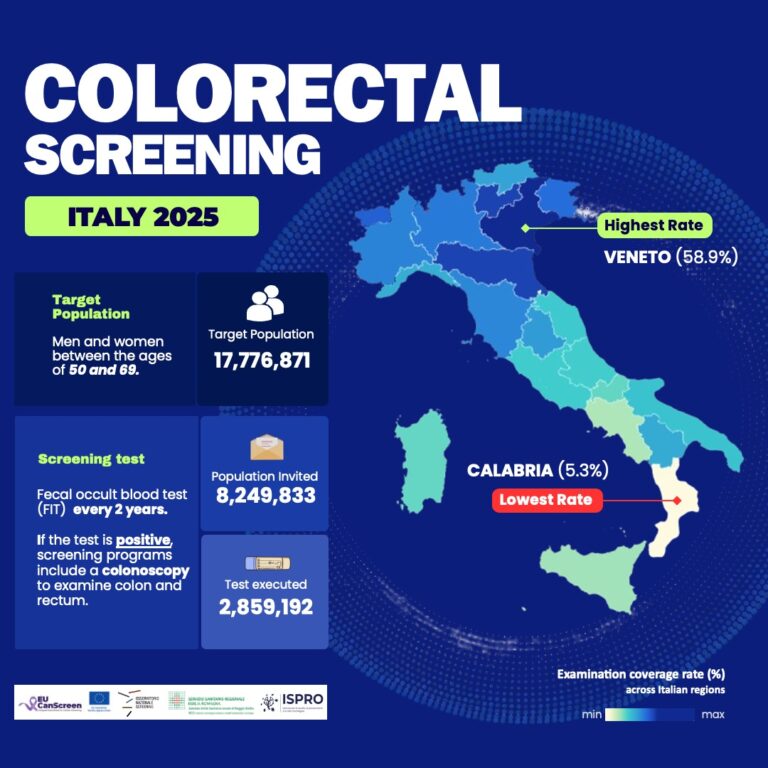
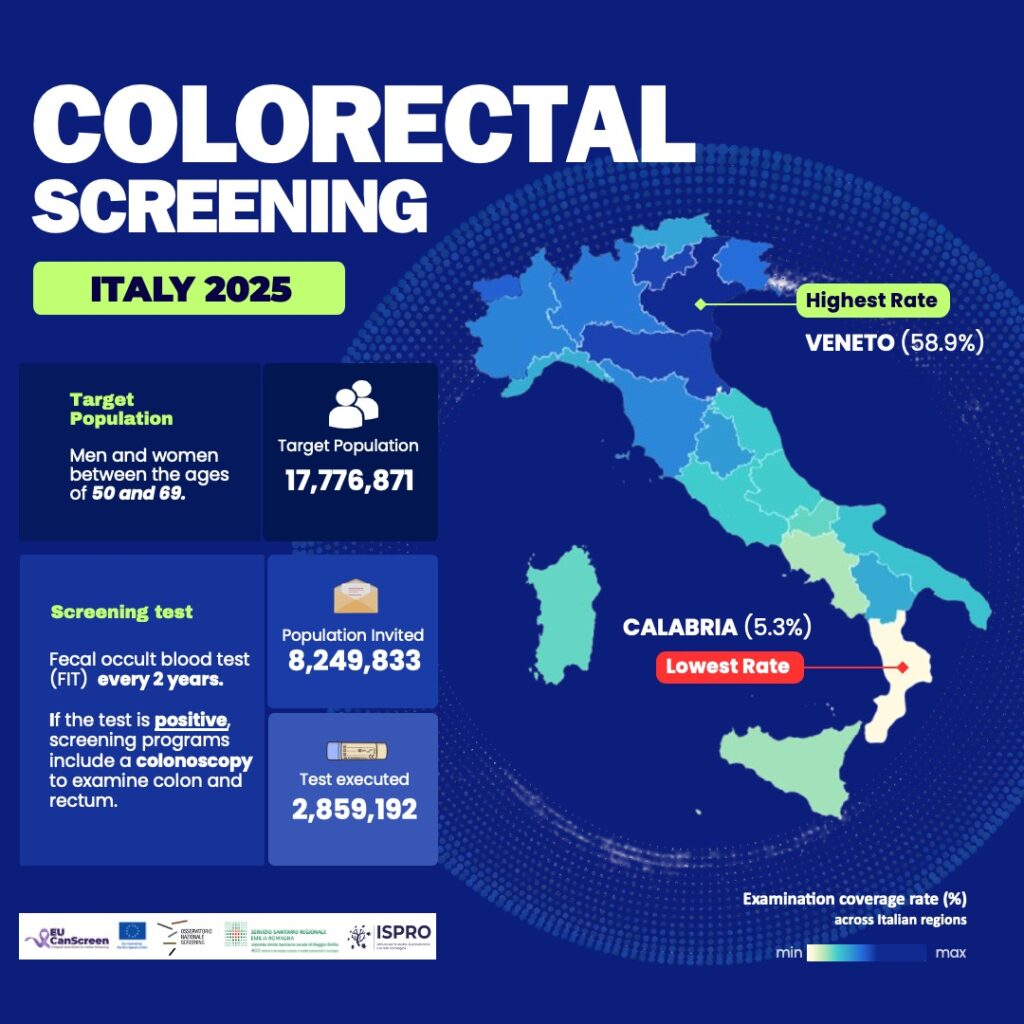
A total of 8,249,833 people aged 50 to 69 were invited to colorectal screening in 2025, corresponding to 98% invitation coverage and an increase of four percentage points compared with 2024.
Invitation coverage reached 101% in the North, 103% in Central Italy and 91% in the South and Islands. For the first time, the southern macro area also reached the acceptable 90% invitation threshold.
Overall, 2,859,192 people completed a faecal occult blood test. National examination coverage reached 35% and remained below the acceptable 50% threshold in all geographical areas. Coverage was 47% in the North, 32% in Central Italy and 20% in the South and Islands.
In recent years, several Regions have developed collaborations with public and private pharmacies to make screening more widely accessible. Participation nevertheless remains influenced by several factors. Vulnerable groups, including migrant populations, tend to participate less, while men also show lower participation despite having a higher risk of developing colorectal cancer. Addressing these barriers requires both organisational and cultural interventions.
Cervical Screening
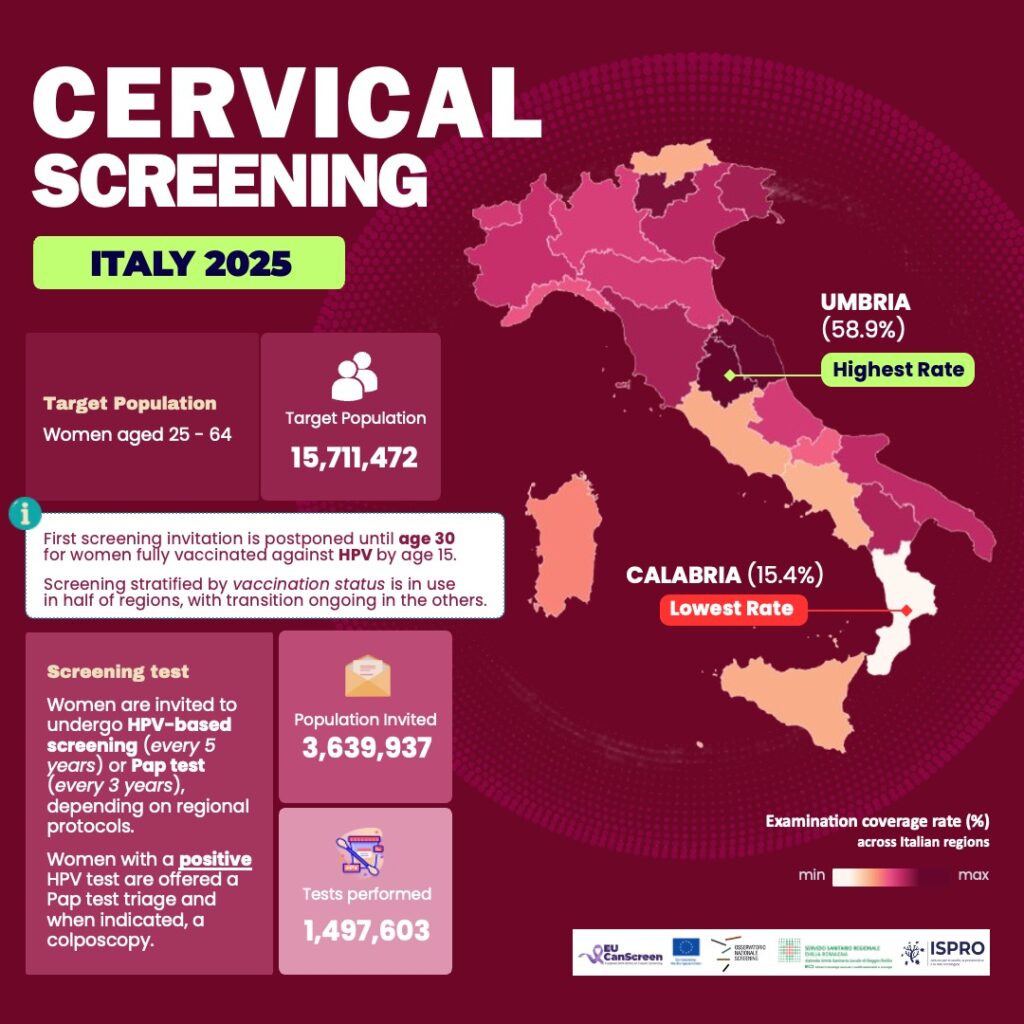
In 2025, 3,639,937 people were invited to cervical screening, with invitation coverage reaching 99%. All three geographical macro areas achieved levels above the acceptable threshold, with 107% in the North, 120% in Central Italy and 99% in the South and Islands.
Values above 100% can occur because HPV testing is performed every five years compared with the three year interval for the Pap test, and because some Regions may invite more people in a given year to recover previous delays.
National examination coverage reached 48%, approximately three percentage points lower than in 2024. Coverage was 55% in Northern Italy, 50% in Central Italy and 38% in Southern Italy and the Islands. Over the 2021 to 2025 period, the South and Islands showed a steady improvement.
Extending screening beyond the current age groups
Some Regions have already expanded mammographic and colorectal screening beyond the age groups currently included in the Essential Levels of Care.
For mammographic screening, invitation coverage reached 32% among people aged 45 to 49 and 50% among those aged 70 to 74. Participation among those invited was 64% and 68% respectively.
For colorectal screening among people aged 70 to 74, invitation coverage reached 44%, nine percentage points higher than in 2024 following implementation of the extension in four additional Regions. Participation among those invited was 46%.
Participation, Equity and Future Priorities
The 2025 data show that average national invitation coverage is above the acceptable 90% threshold for all three organised screening programmes. However, examination coverage remains more challenging because it depends not only on the capacity of health services to provide screening but also on citizens’ participation.
Geographical differences remain significant across all three programmes, although the improvement observed in Southern Italy and the Islands over the last five years is particularly encouraging.
Further extending screening to additional age groups will require continued regional commitment. The National Prevention Plan 2026 to 2031 also provides an opportunity to strengthen screening through dedicated programmes, with greater attention to equity and sustainability. In Southern Italy and the Islands, these actions will complement those already planned under the National Programme for Equity in Health, which aims to promote screening particularly among more vulnerable populations.
Reference Bibliography
2025 Cancer Screening Update – National Screening Observatory (ONS)
https://www.osservatorionazionalescreening.it/content/la-diffusione-degli-screening-oncologici-italia-nel-2025
National Prevention Plan 2020–2025
https://data.consilium.europa.eu/doc/document/ST-14770-2022-INIT/it/pdf
National Cancer Plan 2023–2027
https://www.salute.gov.it/new/it/tema/tumori-e-screening/piano-oncologico-nazionale-2023-2027/
Council of the European Union Recommendations on Cancer Screening
https://data.consilium.europa.eu/doc/document/ST-14770-2022-INIT/it/pdf
Subscribe to our newsletter to get news and updates.

Views and opinions expressed are however those of the author(s) only and do not necessarily reflect those of the European Union or European Health and Digital Executive Agency (HaDEA). Neither the European Union nor HaDEA can be held responsible for them.
This website is managed by 6th DYPEDE, Greece.






This project has received funding from the European Union’s EU4HEALTH Programme under the Grant Agreement no 101162959