
Understanding Cancer Screening Participation Through Population Data
Focusing on analysing barriers and facilitators to participation in cancer screening programmes.
The Italian National Institute of Health, through its National Centre for Disease Prevention and Health Promotion (CNaPPS), contributes to EUCanScreen WP6, which focuses on analysing barriers and facilitators to participation in cancer screening programmes.
Cervical, Breast and Colorectal Cancer Screening
More specifically, within Task 6.3, coordinated by the Region of Southern Denmark, the Italian contribution addresses the individual factors that may hinder participation of target population groups in cervical, breast and colorectal cancer screening.
Within activity 6.3.2, CNaPPS contributes a case study showing how a data-driven approach can identify individual factors that hinder or facilitate participation across different screening programmes and population groups.
PASSI
The analysis is based on PASSI, the Italian population surveillance system, which collects data from adults aged 18–69 living in Italy. Among the information collected are the reasons for non-participation in cancer screening and the factors that may facilitate participation.
PASSI represents a unique contribution within EUCanScreen because it provides data collected continuously, through homogeneous and standardised procedures, with national coverage since 2008. In other participating settings, available evidence mainly comes from studies conducted at specific points in time, often focused on a single screening programme and based predominantly on qualitative approaches.
European Public Health Conference 2025 in Helsinki
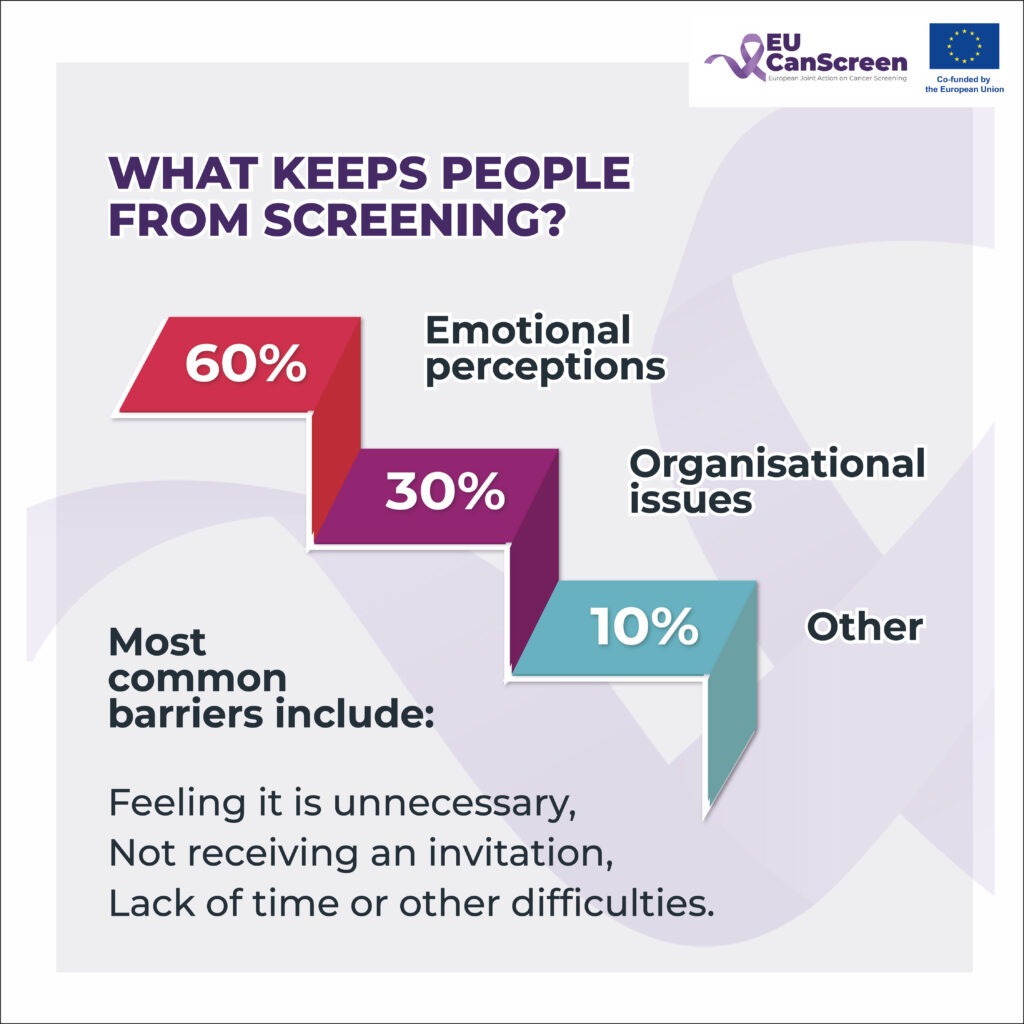
Although cervical, breast and colorectal screening differ in terms of procedures and target populations, analyses presented at the European Public Health Conference 2025 in Helsinki showed the same distribution of reported barriers when grouped into three broad categories: personal perceptions, organisational factors and other reasons.
Beyond the standard results already provided by PASSI, the system also makes it possible to link reasons for non-participation in screening to other factors, including sociodemographic characteristics, health status and exposure to behavioural risk factors.
Primary and secondary prevention develop in an aligned and synergistic way
The Italian contribution also highlights the importance of ensuring that primary and secondary prevention develop in an aligned and synergistic way, in line with the objectives of the Italian National Cancer Plan and Europe’s Beating Cancer Plan.
Further information and resources
- EUCanScreen on the EpiCentro portal
https://www.epicentro.iss.it/screening/jaeucanscreen - “Which are the individual determinants of (non-)engaging behaviours in cancer screenings?”
https://doi.org/10.1093/eurpub/ckaf161.1207 - “Quali sono i fattori che determinano la (non) partecipazione agli screening cervicale, mammografico e colorettale?”
https://epiprev.it/rubriche/quali-sono-i-fattori-che-determinano-la-non-partecipazione-agli-screening-cervicale-mammografico-e-colorettale - European Public Health Conference 2025 presentation
“Which are the determinants of (non-)engaging behaviours in cervical, mammographic and colorectal screenings in Italy?”
https://www.epicentro.iss.it/screening/pdf/DF.PD-NCD-DF.45%20-%20ValentinaPossenti.pdf
This project is co-funded by the European Union.
Subscribe to our newsletter to get news and updates.

Views and opinions expressed are however those of the author(s) only and do not necessarily reflect those of the European Union or European Health and Digital Executive Agency (HaDEA). Neither the European Union nor HaDEA can be held responsible for them.
This website is managed by 6th DYPEDE, Greece.






This project has received funding from the European Union’s EU4HEALTH Programme under the Grant Agreement no 101162959