
Home » Newsletters » Cancer Screening Professionals During The COVID-19 Pandemic, Lessons From An Italian Multiregional Survey
NOVEMBER 2026
Publications & Media Mentions
Cancer Screening Professionals During The COVID-19 Pandemic, Lessons From An Italian Multiregional Survey
We present the findings of a study conducted within the framework of the Italian Ministry of Health’s CCM 2021 multiregional programme, aimed at developing strategies to address the impact of the COVID-19 pandemic on cancer screening programmes and to strengthen preparedness for future emergencies. The study, coordinated by the Emilia-Romagna Region, with ISPRO responsible for the training component, explored the experiences, organisational needs and training requirements of healthcare professionals involved in organised cancer screening programmes during the pandemic.
An Italian survey of screening professionals
The COVID-19 pandemic disrupted cancer screening programmes and created new challenges for the healthcare professionals responsible for delivering them. While the impact on screening participation and diagnostic delays has been widely investigated, the impact on cancer screening workers remains underexplored.
An anonymous online questionnaire was conducted between May and June 2023 among professionals involved in organised cancer screening programmes in Tuscany, Emilia-Romagna and Basilicata. A total of 317 responses were collected. Participants worked across cervical, breast and colorectal cancer screening, as well as in cross-programme roles. The survey examined five key dimensions: psychological well-being and perceived stressors, organisational communication and support, teamwork and collaboration, professional recognition and motivation, and preparedness for future emergencies.
Psychological well-being and organisational support
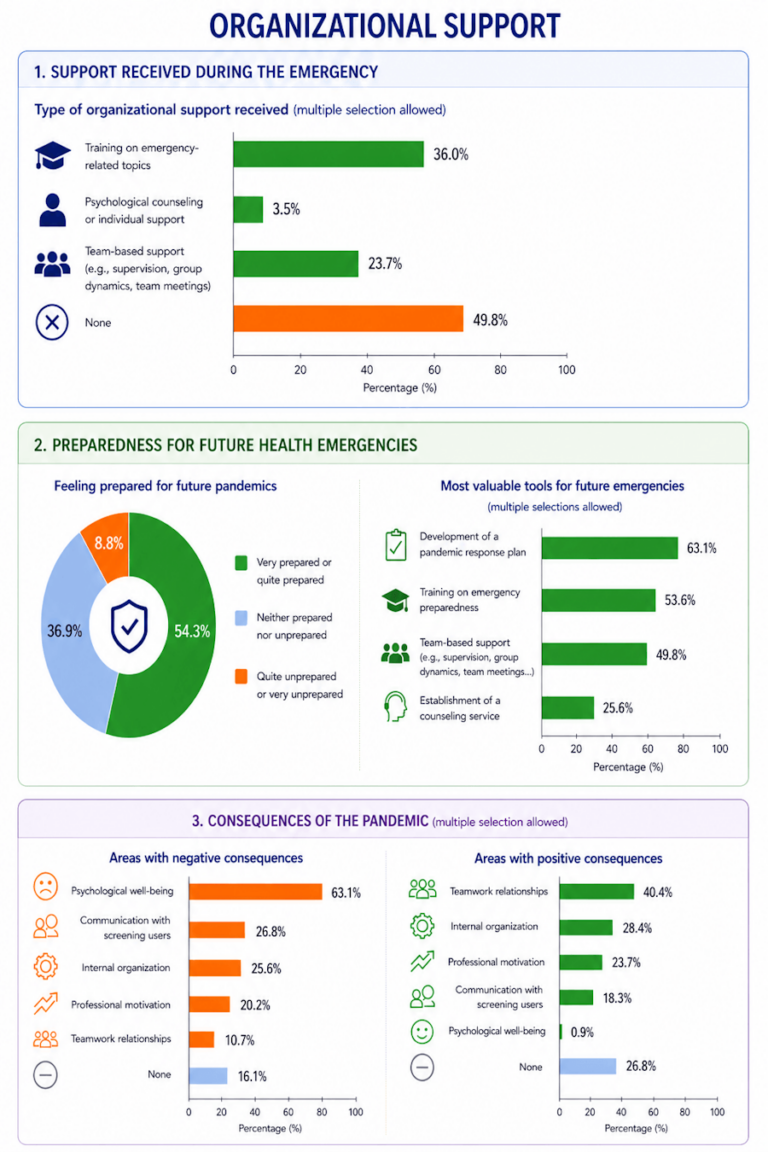
Psychological well-being was the most frequently reported negative consequence of the pandemic, cited by 63.1% of participants. Difficulties were also reported in maintaining work-life balance, with 55.5% experiencing challenges in this area. At the same time, organisational support was limited. Almost half of respondents (49.8%) reported receiving no form of organisational support during the emergency. Emergency-related training was the most frequently reported intervention (36.0%), while only 3.5% received psychological counselling.
Teamwork and adaptation
The experience was not only characterised by difficulties. 87.1% of respondents reported that their workgroup operated in a coordinated and collaborative way during the emergency, while 86.8% shared concerns and difficulties with colleagues. Furthermore, 65.9% reported developing new professional competencies during the pandemic and 76.4% felt useful in their professional role.
Several respondents also described positive organisational changes, including greater adaptability, enhanced teamwork and the introduction of technological solutions. At the same time, increased fatigue and workload, more complex procedures and difficulties in communicating with screening users were reported.
Preparing for future emergencies
The survey highlighted the importance of maintaining the role of cancer screening during future health emergencies. 89.3% of respondents agreed or strongly agreed that the importance of screening should be reaffirmed within the healthcare system, while 92.8% supported reaffirming its importance in society.
When asked about preparedness for future pandemics, 54.3% felt prepared or somewhat prepared, while 36.9% were neutral and 8.8% felt unprepared. The most frequently selected measure for future emergencies was the development of a structured pandemic response plan (63.1%), followed by emergency preparedness training (53.6%) and team-based support (49.8%). Nearly half of participants (46.1%) disagreed with the suspension of first-level screening in the event of a future pandemic.
From pandemic experience to organisational learning
The pandemic acted as an accelerator for innovation, leading to practices that changed how screening services were delivered, such as online booking, telephone and SMS reminders, telemedicine, remote working for specific roles, staff redistribution and more frequent team meetings. However, a critical finding of the study is that many of these valuable best practices and technological innovations were not systematically maintained over time.
Conclusions
The findings highlight that effective crisis management requires a systems-level approach integrating psychological support with key organisational elements, including workload management, institutional recognition and participatory decision-making. Future policies should use these insights to safeguard users and professionals.
The full study is published in Epidemiologia & Prevenzione (2026;50(2)).
Authors
Giulia Maddaleni, Elisa Betti, Paola Mantellini, Screening Unit, ISPRO, Florence, Italy
Subscribe to our newsletter to get news and updates.

Views and opinions expressed are however those of the author(s) only and do not necessarily reflect those of the European Union or European Health and Digital Executive Agency (HaDEA). Neither the European Union nor HaDEA can be held responsible for them.
This website is managed by 6th DYPEDE, Greece.






This project has received funding from the European Union’s EU4HEALTH Programme under the Grant Agreement no 101162959