
NOVEMBER 2026
Project Updates
EUCanScreen Conference: Shaping The Future Of Cancer Screening
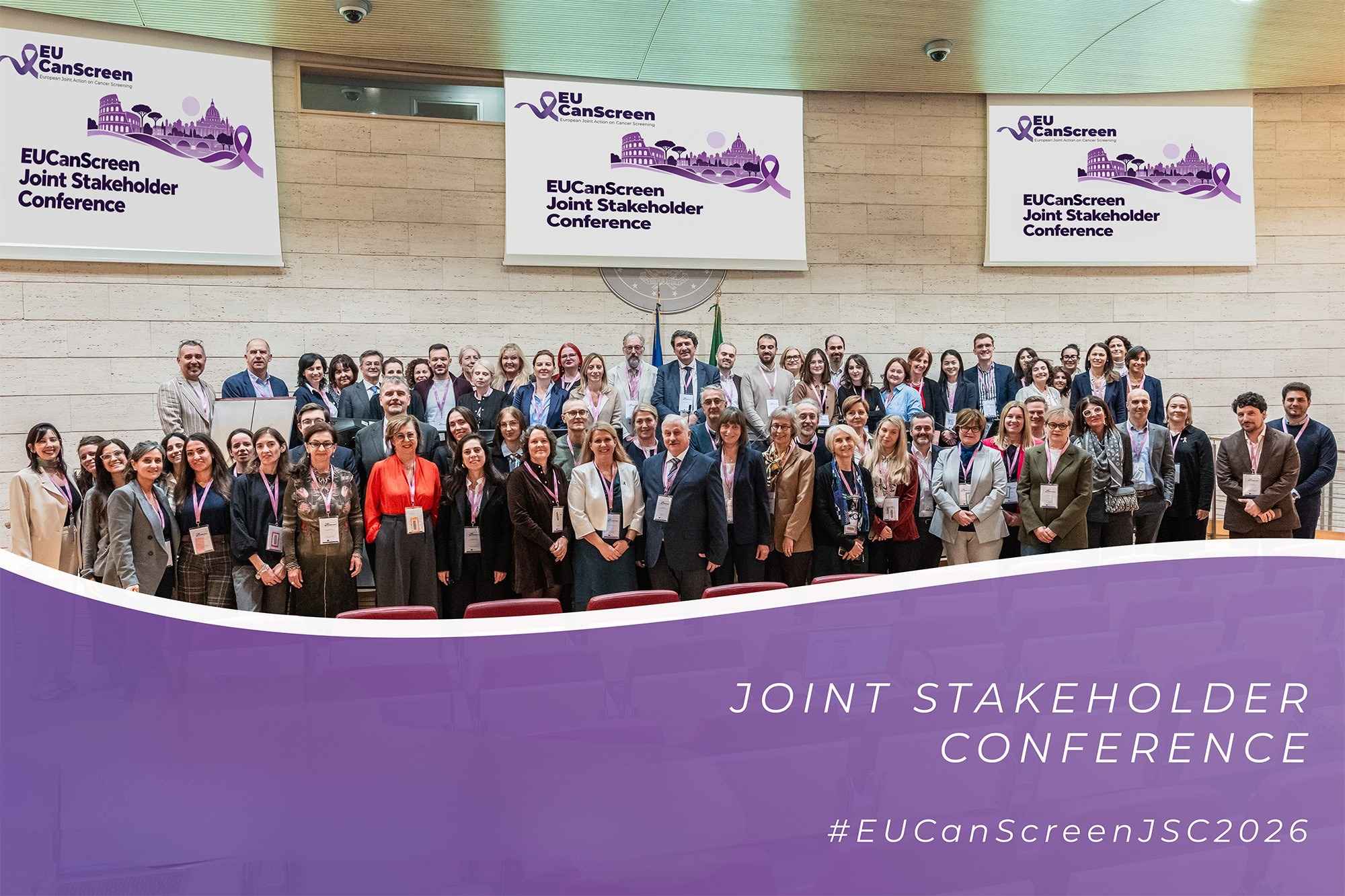
On 28–29 October 2026, the Italian Ministry of Health hosted the EUCanScreen Joint Stakeholder Conference in Rome, bringing together representatives of European and national institutions, healthcare professionals, patient organisations, researchers and project partners. The two-day meeting provided an important opportunity to take stock of the progress achieved during the first 28 months of the Joint Action, share experiences and emerging results, and discuss common priorities and challenges for the future of organised cancer screening in Europe. A key objective was to strengthen dialogue and cooperation among stakeholders, supporting the translation of European recommendations into effective, equitable and sustainable screening programmes at national and regional level.
A central message emerging from the discussions was that expanding population-based screening requires more than scientific evidence and political commitment: it also depends on adequate healthcare infrastructure, sustainable funding, effective governance, qualified professionals and robust quality assurance systems. Particular attention was devoted to the implementation of screening programmes for lung, prostate and gastric cancers, in line with updated European recommendations. National authorities and policymakers were encouraged to assess the readiness of their healthcare systems, including diagnostic and treatment capacity, before introducing new programmes, ensuring that their implementation is supported by appropriate resources and long-term planning.
Healthcare professionals and programme representatives highlighted the importance of integrating screening into well-organised healthcare pathways, supported by qualified staff, reliable information systems, population registries and continuous monitoring. The discussions also stressed that screening should be understood as a comprehensive process, extending beyond the initial examination to include invitation, diagnosis, treatment and follow-up.
Ensuring equitable access to screening was another major priority throughout the conference. Despite progress across Europe, significant differences persist between countries and population groups in participation rates and access to preventive services. Socioeconomic circumstances, geographical barriers, cultural differences and individual needs can all affect people’s ability to access screening. Patient organisations and civil-society representatives brought attention to the importance of placing citizens’ needs and experiences at the centre of programme design, while discussions highlighted the need for healthcare systems to identify and address barriers affecting underserved populations. Innovative approaches such as self-sampling, mobile screening services, tailored communication, cultural mediation and accessible information materials were identified as valuable tools to improve participation, with particular attention to migrants, people with intellectual disabilities and other groups facing specific difficulties in accessing healthcare. The overarching message was clear: equity cannot be taken for granted but must be incorporated into every stage of the screening pathway.
From a European perspective, the conference reaffirmed the added value of cooperation in addressing shared challenges and reducing inequalities between healthcare systems. European institutions, national authorities and project partners emphasised the importance of peer-to-peer exchange, cross-border collaboration and structured capacity-building initiatives to help countries overcome implementation barriers and strengthen their national programmes. Mechanisms such as the Targeted Support Mechanism (TSM), alongside training activities and professional networks, offer concrete opportunities to share expertise and adapt good practices to different national and regional contexts.
Researchers and experts also highlighted the growing potential of digital innovation and health data in shaping the future of cancer screening. Artificial intelligence, interoperable health information systems, common data models and cross-border data sharing could improve programme monitoring, support research and facilitate the development of more personalised and risk-stratified screening approaches. However, participants underlined that technological progress must be accompanied by appropriate safeguards, including data protection, ethical and legal considerations, clinical safety, transparency and human oversight, in order to maintain public trust. The integration of primary, secondary and tertiary prevention was also recognised as an important objective in moving towards more continuous and person-centred approaches to cancer prevention and care. Across the different perspectives represented at the conference, a common understanding emerged: the future of cancer screening in Europe will depend on the ability to combine scientific and clinical evidence, strong political leadership, organisational capacity, digital innovation and meaningful stakeholder engagement.
The concluding discussions reinforced several key messages. First, cancer screening must be considered a continuous healthcare pathway rather than an isolated test, with quality and coordination ensured at every stage. Second, citizens, patients and all relevant stakeholders must be actively involved in the development and evaluation of programmes, through co-design and co-creation processes that help identify real needs and develop accessible, effective solutions. Third, stronger European cooperation, greater harmonisation and evidence-informed decision-making are essential to reduce inequalities between countries and ensure sustained political and financial commitment. Ultimately, the EUCanScreen Joint Stakeholder Conference reaffirmed that improving cancer screening across Europe is a shared responsibility that requires coordinated action at European, national and regional levels. By connecting European priorities with national experience, strengthening capacities and promoting the exchange of knowledge, EUCanScreen aims to support more effective, accessible and sustainable screening programmes, helping ensure that everyone across Europe can benefit from prevention and early detection.
Author
Subscribe to our newsletter to get news and updates.

Views and opinions expressed are however those of the author(s) only and do not necessarily reflect those of the European Union or European Health and Digital Executive Agency (HaDEA). Neither the European Union nor HaDEA can be held responsible for them.
This website is managed by 6th DYPEDE, Greece.






This project has received funding from the European Union’s EU4HEALTH Programme under the Grant Agreement no 101162959